
Four source roles answer four different questions
Research evidence
Peer-reviewed studies answer defined questions. Same-species, reptile-wide and cross-species findings retain different applicability limits.
Professional guidance
Veterinary and specialist sources propose household systems whose measurements and disagreements remain attributed.
Keeper signals
Sampled discussions expose measurement and cohabitation disputes. They do not establish safety or prevalence.
Saurvia synthesis
Saurvia compares the cited roles and preserves unresolved questions. The synthesis is not independent evidence or an active service rule.
A 2008 field report records where and when 24 animals were encountered in northwestern Ghana. It is direct natural-history evidence, but not an enclosure experiment. Two reproductive papers address nest selection and temperature-dependent sex determination; they are useful for preventing cross-species transfer, not for setting adult heat. Current veterinary and specialist care pages offer implementable household proposals. Keeper discussions expose recurring measurement and cohabitation disputes, but cannot resolve them. [Spawls 2008] [Bragg et al. 2000] [Viets et al. 1994]
Keeping those roles separate is not academic caution. It prevents a rainfall association from becoming a permanent humidity setting, a nest temperature from becoming an adult basking target, and a popular equipment preference from becoming a biological requirement.
The Ghana field record describes a moving environment, not one humidity target
Spawls recorded 23 of 24 captures at night over 379 hours of searching. Nineteen of those night captures occurred on the night after rain or the following night, with measured air relative humidity between 60% and 95%. Yet two animals were also active after 62 and 77 rainless days, at measured air relative humidity of 29% and 17%. These observations support sensitivity to time, weather and available microclimates; they do not support either permanently wet air or the claim that moisture is irrelevant. [Spawls 2008]
Twenty-three animals were found on flat or gently sloping open savanna. The only daytime animal was excavated from a rodent burrow ending in a chamber about 35 cm below the surface. The species was principally terrestrial, but two captive animals occasionally climbed inside a hollow vertical branch to about 30 cm. The defensible design lesson is broad usable ground area, multiple close refuges, diggable or insulating opportunities and safe low complexity—not a barren floor, and not an arboreal enclosure. Field air readings and burrow geometry still cannot be pasted into a household specification. [Spawls 2008]
A nest study blocks copied temperatures without supplying adult ones
Bragg and colleagues studied nest-site selection in three eublepharid geckos. African Fat-Tailed Gecko females selected warmer nests on average than Leopard Gecko females, and nest choices varied by species and individual. That is strong evidence against assuming that close relatives share one temperature rule. It is not evidence that an adult should spend each day at the reported nest temperature. The animals, life stage, reproductive behavior, exposure duration and outcome are different. [Bragg et al. 2000]
The comparative incubation literature adds the same boundary. Embryonic development and sex determination belong to breeding and incubation, which this guide excludes. A number does not become more transferable merely because it is precise. [Viets et al. 1994]
Build the enclosure around usable floor and separated choices
Current public guidance disagrees on the enclosure label. Tree of Life uses a 20-gallon-long baseline for one adult; ReptiFiles proposes at least 36 × 18 × 18 inches for one. Neither source reports a controlled space-outcome study, so the figures should retain their attribution rather than be blended into a new “proven minimum.” [Tree of Life] [ReptiFiles]
A planning audit should instead confirm internal floor dimensions, secure closure, ventilation, room for distinct warm and cool refuges, a localized humid refuge, water, cover, useful substrate depth and safe low climbing. The gecko should be able to move between those resources without becoming exposed. More nominal volume does not help if the usable area is empty or a single heat or moisture zone occupies everything.
Heat and moisture need names, positions and time
Tree of Life proposes a warm substrate area of 88–92°F, a cool side of 75–80°F and lower night temperatures, with ambient relative humidity of 50–70% plus a humid hide. ReptiFiles proposes a different, seasonally changing thermal and humidity system. These are not equivalent prescriptions and neither is a controlled same-species outcome threshold. The responsible public use is to show the disagreement, preserve the measurement context and avoid averaging the values into a fictional consensus. [Tree of Life] [ReptiFiles]
Before an animal arrives, verify that the heat source is guarded where relevant, controlled by a thermostat and checked independently at the animal-accessible warm surface, inside the warm refuge and in cool-side air. Record the sensor position and time. A controller setting is not the temperature the gecko receives. General veterinary guidance also rejects hot rocks and calls for a gradient rather than uniform heating. [Merck Veterinary Manual] [keeper discussion sample]
Treat ambient relative humidity, humid-refuge air, substrate moisture, condensation and ventilation as separate observations. A humid refuge can stay locally available while the larger enclosure remains ventilated and avoids saturation. Merck warns that both excessive and inadequate humidity can cause problems and that restricting ventilation to retain moisture can create skin and respiratory risk. More misting is not a safe response to an unexplained shedding, breathing or appetite change. [Merck Veterinary Manual]
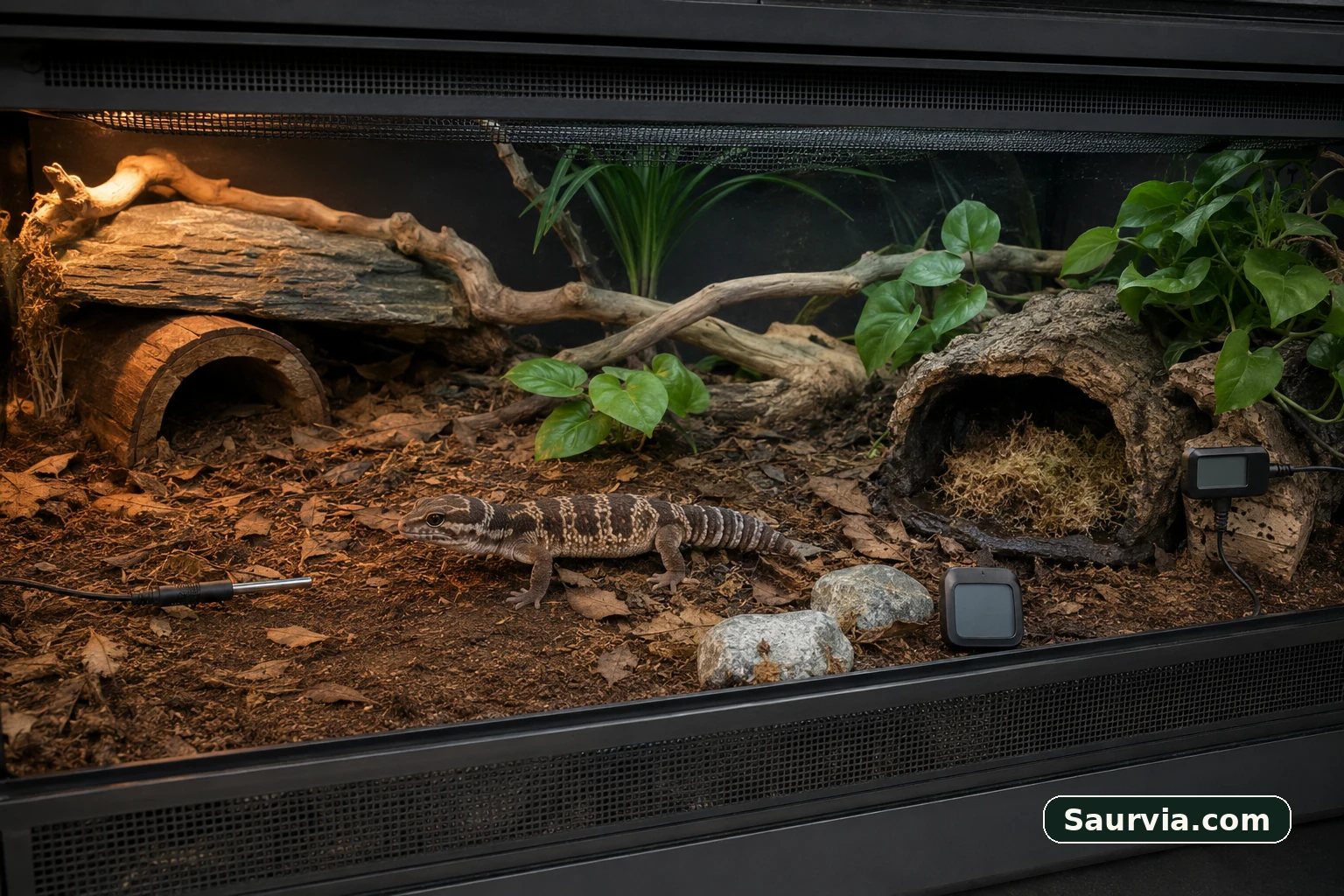
Substrate is a managed system, not a slogan
Tree of Life describes soil, sand and coconut-fibre mixes for routine housing, while recommending paper towel for juveniles or quarantine and warning against calcium sand. ReptiFiles proposes a deeper naturalistic layer. Those positions make context visible: a loose floor can support burrowing and moisture gradients, but only when material, drainage, cleanliness, ingestion opportunity and the animal’s condition are managed. [Tree of Life] [ReptiFiles]
Plain paper remains useful during quarantine, after an uncertain-origin intake or when feces and intake-related debris need close observation. A naturalistic label does not make crushed, dusty, moulding or waterlogged material safe. Use a controlled feeding surface when prey could carry loose particles into the mouth, and change the substrate plan if it prevents meaningful observation.
Quarantine is a separation and evidence process, not a countdown
The reviewed professional sources do not support one universal quarantine duration. Tree of Life’s cleaning guidance says at least 60–90 days, while Merck recommends 3–6 months for new reptiles because incubation periods are often uncertain. A preventive-medicine review likewise treats quarantine, entry control, disinfection and veterinary screening as connected controls. Time alone does not clear an animal whose origin, exposure, signs or test results remain unresolved. [Tree of Life cleaning guidance] [Merck Veterinary Manual] [Pasmans et al. 2008]
- House the newcomer alone in a simple, secure, easily observed setup, separated from resident reptiles and their tools.
- Record origin, arrival mass and photographs, intake, feces and urates, shedding, activity, temperatures and moisture measurements.
- Arrange a reptile-experienced veterinary examination and let origin, exposure history, examination and local disease risk determine fecal or other testing. Repeated fecal examination may be appropriate, but the reviewed sources do not validate “three samples two weeks apart” for every African Fat-Tailed Gecko.
- Treat a new sign, exposure or unresolved result as a reason to reassess the plan and timing with the veterinarian—not as a reason to conceal it behind an elapsed date.
- End quarantine only when the observation record and veterinarian-directed risk plan support integration. Continue individual housing afterward.
Clean first, then disinfect for the identified risk
Remove feces, urates, shed, uneaten insects and contaminated food each day; refresh water and clean the bowl. For a deeper service, move the gecko to a secure temporary enclosure, remove organic debris, wash the surface, then use a material-compatible disinfectant for its labelled contact time. Rinse when the product requires it and let the enclosure and furnishings dry and ventilate fully before reintroduction. Keep quarantine tools dedicated and work with quarantined animals after established animals. [Tree of Life cleaning guidance]
Merck notes that bleach can be used only with thorough rinsing, but neither reviewed source makes a 1:32 dilution or a monthly full substrate change universally correct. Product, pathogen, surface, organic load, contact time and enclosure design change the answer. Persistently wet or contaminated bedding and restricted ventilation are the defensible risks; naming Aspergillus or Candida as a likely species outcome would exceed the evidence in this packet. [Merck Veterinary Manual] [Merck reptile disorders]
Insect nutrition, calcium and UVB form one system
African Fat-Tailed Geckos are managed as live-insect feeders, but an insect name does not describe its nutritional contribution. General veterinary guidance calls for varied feeders, appropriate feeder nutrition and calcium management. Tree of Life and ReptiFiles add different supplementation and lighting formulas. No direct long-term study in this species validates one exact household schedule, so combining the most aggressive parts of several sources would manufacture a protocol rather than synthesize evidence. [Merck Veterinary Manual] [Tree of Life] [ReptiFiles]
For an actionable starting proposal, Tree of Life recommends daily feeding for juveniles and three to four feedings per week for adults, insects no larger than the space between the gecko’s eyes, and 24–48 hours of gut-loading. ReptiFiles uses a different age- and body-condition-linked schedule. These are practical source proposals, not a validated universal African Fat-Tailed Gecko feeding trial; record what is offered, what is eaten and the animal’s longitudinal body trend. [Tree of Life] [ReptiFiles]
Plan the whole system: identified feeder species and sizes, gut-loading, the actual calcium and vitamin products, how often each is used, measured UV exposure at gecko-accessible positions, complete shade and the animal’s intake and body trend. A lamp marked “5%” and a measured UVI are not the same quantity. Tree of Life proposes a low-output 2–5% lamp label; ReptiFiles proposes UVI 1.0–2.0. Neither proposal proves that one measured UVI or oral D3 alone is sufficient for every animal. Do not add or stack unreviewed supplements merely because UVB is present or absent.
Excess vitamin D can be harmful: a published case in a Blue-Tongued Skink linked intensive supplementation with vitamin D toxicosis and abnormal mineralization. That case does not establish an African Fat-Tailed Gecko dose, but it supports a clear safeguard: keep a written inventory of every calcium and vitamin product, avoid overlapping D3 sources, and have the complete UVB and supplement plan reviewed rather than escalating it by guesswork. [Vergneau-Grosset et al. 2020]
Mealworms appear among feeder options in the reviewed professional guidance. This packet did not identify same-species evidence that chitin alone causes juvenile impaction. The safer claim is narrower: keep prey appropriately sized, vary feeder species, maintain measured thermal and hydration choices, avoid contaminated or particle-carrying feeding conditions, and investigate reduced intake, straining or fecal change instead of diagnosing “chitin impaction” from the feeder name. [Merck Veterinary Manual] [Tree of Life]
A tail is one observation, not a diagnosis
Spawls recorded mass, body length and whether tails were original or regenerated in a small field sample. That does not validate a visual “healthy tail” score for household use. Tail outline should be recorded alongside body mass, overall body condition, feeder offers and intake, feces, shedding, activity, reproductive context and change over time—not interpreted alone. [Spawls 2008]
African Fat-Tailed Geckos can autotomize and regenerate the tail. A same-species laboratory study included this gecko in analyses of original and regenerated tails, so the claim that eublepharids have only weak autotomy is not a safe handling premise. Never lift, pin or restrain the animal by its tail. A dropped tail is biologically consequential, not a cosmetic event; active bleeding, swelling, discharge, discoloration or progressive body loss requires prompt veterinary assessment. [Boozalis et al. 2012]
No validated household body-condition score for this species was found in the reviewed packet. Pelvic prominence, skull contour or a tail-to-body-width ratio should therefore not be presented as a validated numeric scale. Veterinary assessment can combine a whole-body examination and palpation with mass, muscle and fat distribution, abdomen and reproductive context; the keeper’s most reliable contribution is a consistent longitudinal record. The packet also cannot support the prevalence claim that obesity is more common than thin body condition in this species.
Establish an arrival baseline and preserve origin and feeding records. A sudden or persistent change in appetite, mass, tail, feces, breathing, posture or activity needs reptile-experienced veterinary review rather than force-feeding, repeated environmental changes or a diagnosis inferred from appearance. Merck’s general guidance supports species identification, quarantine and longitudinal records because apparently similar reptiles and apparently simple signs can require different management. [Merck Veterinary Manual]
Warning signs are action prompts, not home diagnoses
Metabolic bone disease, respiratory infection, stomatitis, dermatitis, reproductive disorders, prolapse and parasites are recognized across reptile medicine. The reviewed evidence does not establish how common each is in captive African Fat-Tailed Geckos, so this guide does not label them “common species diseases.” Observable change and urgency are more useful to a keeper than an unsupported prevalence list. [Merck reptile disorders]
Contact an emergency or reptile-experienced veterinarian immediately
- open-mouth or labored breathing at rest, or marked nasal discharge;
- collapse, seizures, loss of motor control, inability to right, or severe weakness;
- prolapsed tissue, uncontrolled bleeding, a suspected fracture or a significant thermal burn;
- repeated straining with weakness, swelling or a suspected retained egg.
Arrange a prompt examination rather than waiting for a fixed deadline
- progressive mass or tail loss, or a persistent appetite change—especially with altered activity, posture or feces;
- purple-red mouth spots, swelling, damaged oral tissue, excess saliva or discharge from the mouth, nose or eyes;
- skin redness, blisters, ulcers, discharge, abnormal discoloration or a shedding problem that does not resolve after measurements are checked;
- repeated diarrhea, blood or mucus, abnormal urates, regurgitation, straining or a sustained change from the animal’s fecal baseline;
- visible mites or another unexplained progressive body change.
A two-week appetite rule is too blunt: reproductive state, temperature, acclimation, age, body reserves and concurrent signs change urgency. Do not force-feed or start medication while waiting. Preserve measurements, weights, photographs, feeding and fecal records for the veterinarian. [Merck reptile disorders]
Individual housing is the conservative planning baseline
Public guidance is not consistent. ReptiFiles states one gecko per enclosure, while Tree of Life describes some pair or group arrangements. Keeper discussions repeat both positions and frequently borrow Leopard Gecko analogies. None of those sources supplies adequately powered, individual-level outcome data for cohabited African Fat-Tailed Geckos. [ReptiFiles] [Tree of Life] [keeper discussion sample]
Outside a controlled breeding context, plan one African Fat-Tailed Gecko per enclosure. This avoids hidden competition for heat, humidity, food, water and refuges, and keeps intake, feces, shedding, mass and behavior attributable to the correct animal. “No fighting seen” does not establish equal access.
Behavior and welfare require choices plus an individual baseline
Daytime hiding is expected in a principally nocturnal species and is not, by itself, a stress diagnosis. A newly arrived gecko may also eat or explore differently, but “acclimation” should not become a grace period that excuses progressive weight loss, abnormal breathing, neurologic change, discharge or other warning signs. Record when hiding, feeding and exploration occur and compare change with the same individual under measured conditions.
Repetitive interaction with a glass boundary, repeated escape attempts, sustained exposure because no refuge is used, or a new refusal to emerge can prompt a resource audit: verify temperature and moisture at the animal’s positions, cover, refuge fit and distribution, lighting, disturbance, prey presentation and recent changes. None of these behaviors identifies a disease on its own.
Offer controllable opportunities rather than random novelty: multiple close-fitting refuges, diggable substrate where monitoring permits, safe low structure, cover between resources and varied but trackable foraging presentation. Change one nonessential feature at a time, preserve access to established refuges and measure use, avoidance, intake and body trend. A reptile-wide zoo survey found structural and dietary enrichment common but also emphasized taxonomic and evaluation gaps; it is not an African Fat-Tailed Gecko outcome trial. [Bartolomé et al. 2023]
The Five Domains—nutrition, environment, health, behavioral interactions and mental state—can organize a welfare audit, but naming the framework does not validate a species-specific score. In this guide, its practical value is to stop one good-looking domain, such as a thick tail or a decorated enclosure, from hiding deficits in the others.
Intentional seasonal cooling belongs to breeding management and remains outside this guide. ReptiFiles proposes a seasonal cycle, but the reviewed packet does not establish deliberate brumation or cooling as necessary for the health of a nonbreeding pet. Reduced intake or activity should not be labelled “normal brumation” until actual temperatures and other warning signs have been assessed. [ReptiFiles]
Nine common claims after the missing context is restored
| Claim A | Claim B | Same measurement or context? | Evidence state | What remains unresolved |
|---|---|---|---|---|
| An African Fat-Tailed Gecko is a Leopard Gecko with higher humidity. | Rules for either species can be transferred if the values look plausible. | No. Relationship does not erase species, life-stage, reproductive-context or measurement differences. | Field observations describe African Fat-Tailed Geckos in Ghana. A nest-choice study found species-specific reproductive temperatures in related eublepharid geckos. | Direct adult captive-outcome studies that test defined thermal, moisture and housing exposures in this species. |
| The field study proves that enclosure humidity should stay high. | Dry-season captures prove that humidity does not matter. | No. Rain timing, air relative humidity, underground refuge conditions, substrate moisture and captive humid-hide exposure are different variables. | Nineteen of 23 night captures followed recent rain, but two geckos were found after long rainless periods at measured air relative humidity of 29% and 17%. The study did not inspect a captive enclosure. | Sensor-positioned captive humidity cycles linked to hydration, shedding, skin, respiratory and behavioral outcomes. |
| The incubation study supplies the adult warm-side temperature. | Leopard Gecko temperatures are close enough for routine use. | No. Nest selection by reproductive females and embryo development are not adult daily thermoregulation. | The nest study reported species- and female-specific choices and a higher mean for African Fat-Tailed Gecko nests than Leopard Gecko nests. | Adult preferred-temperature and long-duration outcome studies using measured animal-accessible surfaces and air. |
| A thermostat set point proves the gecko receives the intended heat. | Choosing a heat mat or an overhead source settles the thermal question. | No. Device setting, substrate surface, hide interior, nearby air and the gecko’s position can diverge. | Current veterinary guidance requires a measured gradient and thermostatic control. A keeper discussion sample shows a large mismatch between a controller setting and a hide-level probe. | Comparative same-species outcomes across heat-delivery methods when accessible conditions are held equivalent. |
| A 20-gallon long label completes the enclosure plan. | A 36 × 18 × 18 inch enclosure is a proven biological minimum. | No. Nominal volume, internal floor dimensions, refuge access, cover, usable substrate depth and gradient quality are separate properties. | Tree of Life gives a 20-gallon-long adult baseline; ReptiFiles proposes 36 × 18 × 18 inches for one. Neither is a controlled space-outcome trial. | Preference and welfare studies that isolate floor area, furnishing, cover and resource distribution. |
| Loose substrate inevitably causes impaction. | A naturalistic label makes any loose substrate safe. | No. Material, particle size, moisture, contamination, feeding surface, animal condition, ingestion opportunity and monitoring all matter. | Professional sources support naturalistic substrates in managed contexts and paper during quarantine or close monitoring, while warning against specific readily swallowed products. | Same-species comparisons that report ingestion, gastrointestinal and behavioral outcomes under defined husbandry conditions. |
| Nocturnal means UVB has no role. | A bulb percentage or one UVI proposal proves a complete supplementation plan. | No. Lamp percentage, measured UVI, distance, mesh, shade, feeder calcium, gut-loading and oral supplements are different parts of one system. | Tree of Life proposes a low-output lamp; ReptiFiles proposes measured low-level UVI; Merck gives broader reptile guidance. No direct same-species dose-response settles the system. | Long-term African Fat-Tailed Gecko trials measuring UV exposure, diet, calcium status and clinical outcomes together. |
| A thick tail proves the gecko is healthy. | Appetite or tail change can be interpreted without the rest of the record. | No. Tail appearance, body mass, body condition, intake, feces, shedding, activity and reproductive context are separate observations. | The field paper recorded body and tail measurements and distinguished original from regenerated tails; it did not validate a household tail-health score. | Reference intervals and longitudinal outcome data by age, sex, origin, reproductive state and tail history. |
| Two females can live together if there is no visible fighting. | One calm observation proves equal access to resources. | No. Displacement from hides, food or preferred conditions can occur without an obvious fight and makes individual records difficult to interpret. | Current public guidance conflicts: ReptiFiles specifies one per enclosure, while Tree of Life describes some group configurations. Keeper discussions repeat both positions without outcome data. | Adequately powered studies of group composition, resource access, individual behavior and delayed health outcomes. |
Quick reference: proposals, checks and unresolved limits
This table is a navigation aid, not a new Saurvia care formula. Each number remains attached to the source that proposed it, and each check describes what the keeper can verify without pretending that the direct outcome evidence is complete.
| Area | Source-attributed planning reference | What to verify or keep unresolved |
|---|---|---|
| Housing | One animal per enclosure. Tree of Life uses a 20-gallon-long adult baseline; ReptiFiles proposes 36 × 18 × 18 inches. | Internal floor dimensions, secure closure, separated refuges, cover, useful substrate and low structure. Neither size is a controlled outcome threshold. |
| Heat and moisture | Tree of Life proposes an 88–92°F warm substrate area, 75–80°F cool side and 50–70% ambient RH plus a humid refuge; ReptiFiles proposes seasonal values. | Animal-accessible surface, refuge interior and cool-side air; ambient RH, humid-refuge air, substrate moisture and ventilation as separate records. |
| Feeding | Tree of Life proposes juveniles daily, adults three to four times weekly, prey no larger than the space between the eyes and 24–48 hours of gut-loading. | Feeder identity and size, preparation, offers, intake, feces and longitudinal body trend. ReptiFiles uses a different schedule. |
| UVB and supplements | Tree of Life proposes a low-output 2–5% lamp label; ReptiFiles proposes UVI 1.0–2.0. | Measured UVI, distance, mesh, shade, feeder calcium, every product and frequency. No direct same-species dose-response validates one complete formula. |
| Quarantine and hygiene | Tree of Life says at least 60–90 days; Merck recommends 3–6 months. Remove waste and uneaten prey daily. | Separation, dedicated tools, records and veterinarian-directed testing. Product, surface, pathogen and soiling—not a universal dilution or monthly reset—determine disinfection. |
| Health record | Arrival mass and photographs, feeding, feces and urates, shedding, activity, climate measurements and veterinary findings. | Change from the individual baseline. Tail width alone and the proposed visual BCS ratios are not validated diagnostic scales. |
What should be working before the gecko arrives
The current source-attributed planning baseline is one confidently identified, captive-bred African Fat-Tailed Gecko in a secure, ventilated horizontal enclosure. Record the internal floor dimensions rather than relying only on a gallon label. Provide separate close-fitting warm and cool refuges, a localized humid refuge, cover, clean water, managed substrate and safe low structure. Guard and thermostat-control heat, then independently measure the animal-accessible warm surface, refuge interiors and cool-side air. Track ambient and humid-refuge conditions separately.
Merck’s requirement for thermostatic control and a thermal gradient supports checking the enclosure under normal room conditions before acquisition. Record whether the planned warm surface, refuge interiors and cool-side air remain distinct across the intended day–night cycle. Merck does not specify a number of commissioning days, so this guide does not add one. The feeding plan should name the varied insects, feeder preparation, supplements and measured lighting arrangement as one system. Keep origin, arrival mass, body and tail photographs, intake, feces and shedding records. Identify a reptile-experienced veterinarian and maintain individual housing. These steps are source-attributed planning safeguards, not newly validated species thresholds. [Tree of Life] [Merck Veterinary Manual] [ReptiFiles]
The missing studies have specific jobs
Useful thermal work would measure adult preferences, accessible surfaces, refuge interiors, air, exposure duration and long-term outcomes together. Moisture studies need named sensor positions, ventilation, substrate condition and shedding, skin, respiratory and behavioral outcomes. Space research should separate floor dimensions from cover, refuge distribution and substrate depth. Nutrition and UVB trials must report the complete feeder, supplement and exposure system rather than one product variable.
Social-housing research would need individual identification, resource access, body trends and delayed outcomes; tail research would need longitudinal reference data rather than visual scoring. Until those studies exist, revisions should be triggered by direct same-species evidence, materially changed veterinary guidance or a documented safety correction—not by the popularity of a care slogan.