
The rack debate begins with the wrong outcome
A Ball Python that eats regularly has supplied one useful observation: it ate. That result cannot, by itself, describe locomotion, hiding choice, climbing, thermal access or the animal's response to a more complex environment. The same problem appears in the opposite direction. Calling an enclosure “naturalistic” does not show that its space, cover or gradients work.
This guide concerns a healthy, captive-bred Python regius with known identity and history. It excludes uncertain-origin animals, breeding, deliberate fasting, owner-led assisted or force feeding and clinical care. Sources were checked through July 27, 2026 under Saurvia's public methodology. The article organizes evidence and attributed guidance.
Three source roles, three different jobs
Direct research
A same-species housing comparison and a later mixed-species hormone pilot address defined outcomes under declared conditions.
Professional guidance
Welfare and veterinary sources provide household implementation baselines and safety boundaries.
Keeper signals
Sampled discussions locate practical conflict around racks, humidity, equipment and feeding refusal. They do not measure prevalence or prove causation.
The same 35 snakes behaved differently after the housing changed
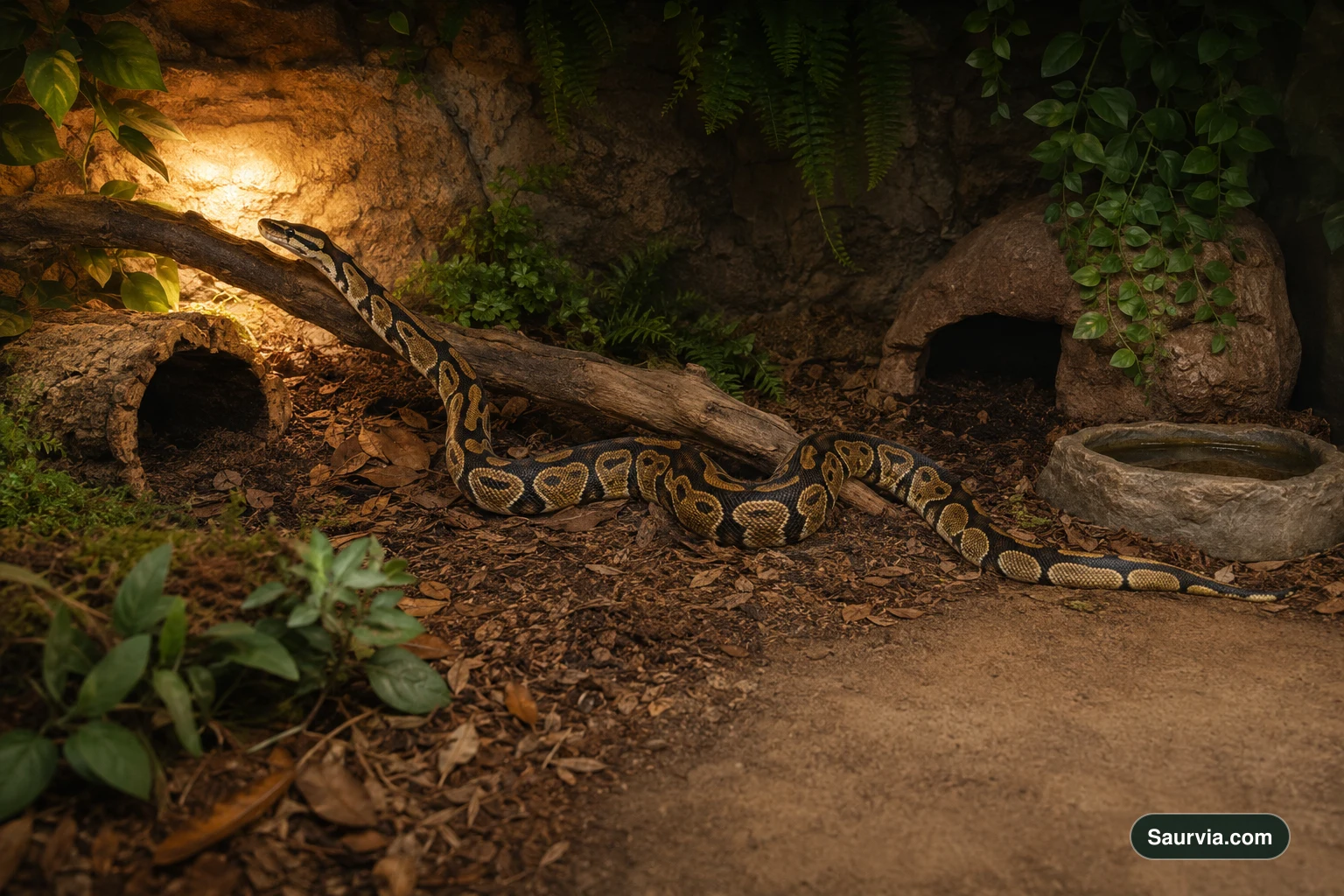
Hollandt, Baur and Wöhr observed 35 individually housed Ball Pythons measuring 53–148 cm in conventional racks, then moved the same animals to furnished terraria after at least eight weeks. Depending on body length, the terraria measured 100 × 50 × 50, 120 × 60 × 60 or 150 × 80 × 80 cm. They included substrate, a hide, climbing structure, a bathing basin, an elevated basking site and plants. The observed behavior spectrum differed between conditions. Basking, climbing, burrowing and bathing occurred only in the terraria; behavior the authors considered potentially stereotypic appeared almost exclusively in racks. [Hollandt et al. 2021]
The within-animal design avoids comparing unrelated groups, but the order was fixed: racks first, terraria second. Housing changed alongside time, experience and the move itself. The study also compared two complete systems, not isolated variables. It supports furnished space that permits a broader behavioral repertoire. It does not identify the effect of every dimension, object or lamp separately.
A hormone pilot measured a different question
A 2026 pilot collected 58 fecal samples across three phases from 12 snakes representing four species; four were Ball Pythons. Fecal glucocorticoid-metabolite concentrations varied markedly among individuals, and the researchers found no significant difference between rack and enriched-terrarium phases. [Olvera-Maneu et al. 2026]
That result does not erase the behavioral finding. Four Ball Pythons in a mixed-species pilot provide little power for a species-specific housing threshold, and a fecal hormone measure is not the same endpoint as climbing, burrowing or abnormal repetitive behavior. The useful reading is narrower: the pilot did not detect a housing effect with this measure and sample. It also shows why one biomarker should not be treated as a complete welfare score.
An adult planning floor must still scale with the snake
Current RSPCA guidance requires internal length that allows full extension, with width and height each at least one-third of body length. Its worked example for a 120 cm snake is 120 × 40 × 40 cm. The same guidance requires several close-fitting hides and substantial cover; a young snake may use a smaller enclosure that grows with it or a larger enclosure furnished with many small, confined spaces. [RSPCA]
The worked example is a guide minimum, not a controlled outcome threshold or proof of an optimum. It can also be read too literally: a narrow footprint may leave little room for a water basin, two secure hides, turning, climbing structure and real thermal separation. For adult acquisition planning, Saurvia therefore uses 120 × 60 × 60 cm internal as the smallest starting footprint. Length must still permit full extension. A 150 cm snake consequently needs at least about 150 cm of internal length, and any individual needs more space when the required functions cannot coexist inside the nominal minimum.
That planning safeguard combines the RSPCA full-extension rule with the functional space represented in the housing study; it is not a validated clinical threshold and it remains inactive in Assessment. This is not a choice between a tight box and an exposed room. Measure usable internal dimensions, then inspect whether the snake can move between secure warm and cool retreats without crossing an open field. Sturdy branches, visual cover, water and a suitable substrate add functions. Decorative density without stable routes and hides does not.
Record what reaches the snake, not what the equipment promises
For an adult enclosure, current RSPCA guidance starts with guarded overhead heat under thermostat control. It allows a heat mat for a smaller enclosure only when the mat is beneath or otherwise outside the enclosure, protected from direct contact, controlled by an on/off thermostat and monitored by a probe directly over it. This is a safety distinction, not permission to trust a device label. Exposed lamps, unguarded elements, misplaced probes, insulating substrate and uncontrolled contact surfaces can all create burns. Check the warm surface independently after setup and after any change. [RSPCA] [VCA]
The same RSPCA guide proposes a 30–32°C basking zone and a 24–26°C cool end, verified at the animal's level. A thermostat probe helps control the source; it does not replace measurements of the resulting air and surfaces. A 2014 laboratory study raised the chamber temperature for digesting Ball Pythons from 30 to 40°C over ten hours. It investigated oxygen transport near an upper thermal limit—not a household basking optimum—and two of six digesting snakes regurgitated at 40°C. It cannot establish that 32–35°C is routinely necessary for digestion. [Fobian et al. 2014]
Humidity needs the same discipline. The RSPCA proposes about 50–60% relative humidity at the cool end, with a temporary rise to around 80% that is allowed to fall between increases. It also calls for more ventilation if humidity remains high. Cool-end relative humidity, whole-enclosure humidity, a localized humid hide, wet substrate and condensation are not interchangeable conditions. MSD gives a broader 50–80% range for Ball Pythons; the reviewed material does not establish 60–70% as a universally safer baseline. Treat 50% as the lower edge of a named cool-end reading, not a goal for every surface and hour. Record sensor location, daily range, ventilation, surface moisture and shedding history beside the number. [RSPCA] [MSD Veterinary Manual]
The same guide proposes a low-output 2–7% UVB tube over roughly one-third to one-half of the enclosure, installed at the manufacturer's distance and checked at snake level. Its target is a gradient from UVI 1.0 at basking access to zero in shade; for some albino morphs, it gives a maximum of 0.7. A direct 2013 study followed 14 Ball Pythons for 70 days and found no association between UVB exposure and plasma 25-hydroxyvitamin D3 or ionized calcium. The small study did not measure shedding quality, skin condition, behavior or whole-animal welfare, so it neither proves the claimed broad benefits nor establishes that measured low-level UVB has no other value. The defensible action is to provide a measured low-UVI opportunity with complete shade, while keeping the claimed outcome uncertain. A lamp percentage alone cannot show the UVI available to the animal. [RSPCA] [Hedley and Eatwell 2013]
Food refusal is a trend to investigate, not a species joke
Current RSPCA guidance uses frozen-then-thawed rodents, with prey slightly wider than the snake's widest point. It gives a starting interval of five to six days for young snakes and seven to fourteen days for adults, adjusted to weight. MSD Veterinary Manual also advises against live rodents because they can injure the snake and create a welfare problem for the prey. [RSPCA] [MSD Veterinary Manual]
A schedule is only the beginning of the record. Keep prey identity and size, offer and refusal dates, regurgitation, weight and body-condition trend together. Shed, season, reproductive state, environmental change and health can alter the context, but none can be diagnosed from a reputation for “picky” feeding. The RSPCA advises consulting a reptile-specialist veterinarian when a Ball Python suddenly stops feeding. Repeated prey escalation does not resolve the missing cause. [RSPCA]
Do not push prey into the mouth or throat, tube feed, or attempt assisted feeding at home. An ARAV clinical proceedings paper begins with diagnostic investigation and treatment of the cause before force feeding. It also describes whole-prey force feeding as highly stressful, often requiring sedation, and notes that the snake's thin-walled esophagus is easily injured or perforated. These are veterinary procedures, not keeper techniques for the first or repeated refusal. [Barten 1995]
Security, usable enrichment and solitary housing are checked separately
Test doors, lid, vents, cable routes, latches and equipment penetrations after setup and after every change. Current RSPCA guidance advises running the complete enclosure for a week before the snake arrives. That period is useful only if temperatures, humidity, lighting and escape points are actually checked. [RSPCA]
Provide several close-fitting hides across the gradient, sturdy climbing structure, cover, water and a localized humid retreat. House one Ball Python per enclosure. Individual housing also keeps feeding, weight, feces, shedding and behavior attributable to the correct animal. [RSPCA]
Seven arguments that change when the measurement is restored
| Claim A | Claim B | Same measurement or context? | Evidence state | What remains unresolved |
|---|---|---|---|---|
| Reliable feeding in a rack proves that the housing is adequate. | Every large terrarium improves welfare by itself. | No. Feeding, body condition, behavior, usable space, cover and environmental choice are different observations. A bare, exposed enclosure is also a different condition from the furnished terraria studied. | In a fixed-order comparison of 35 Ball Pythons, furnished terraria allowed a broader behavioral repertoire than racks. The study did not test every rack or terrarium design. | Randomized or counterbalanced same-species comparisons that separate enclosure dimensions, cover, furnishings, light and acclimation. |
| Ball Pythons hide, so they do not need room to extend or climb. | Open space is harmless as long as the enclosure is large. | No. Space and security are not alternatives. The snake needs room to move while retaining close-fitting retreats and cover across the gradient. | Same-species research recorded climbing, basking, burrowing and bathing only in the furnished terraria. RSPCA guidance pairs full extension with multiple hides and cover. | Outcome-linked dimensions and furnishing densities across life stages, body sizes and individual histories. |
| A thermostat makes any heat source safe. | The words “overhead” or “heat mat” prove that a setup is safe or unsafe. | No. Source position, guard, wattage, controller type, probe contact, substrate, surface temperature, cool-side air and animal access all change the exposure. | RSPCA guidance begins with guarded overhead heat for an adult enclosure and permits a protected, externally mounted heat mat for a smaller enclosure only with direct thermostat control. Veterinary guidance warns that exposed or poorly controlled heat can burn reptiles. | Same-species comparisons of heat architecture, probe placement, substrate and sustained animal-level exposure. |
| A humidity target applies everywhere in the enclosure at all times. | A humid hide makes ambient measurement unnecessary. | No. Cool-end relative humidity, warm-end conditions, a localized humid hide, substrate wetness, condensation and ventilation describe different exposures. | RSPCA guidance proposes about 50–60% at the cool end with a temporary rise toward 80%; MSD lists a broader 50–80% Ball Python band. Neither source validates 60–70% as a universally safer whole-enclosure target. | Standardized, sensor-defined humidity cycles linked to shedding, skin and respiratory outcomes in Ball Pythons. |
| A low-light snake receives no useful information from UVB. | Installing a UVB-labelled lamp proves adequate exposure. | No. Species activity label, lamp percentage, distance, obstruction, animal-level UVI and access to shade are not interchangeable. | RSPCA guidance proposes UVI 1.0 at basking access to zero in shade. In a 14-snake, 70-day study, UVB exposure was not associated with plasma 25-hydroxyvitamin D3 or ionized calcium; shedding, skin and overall welfare were not tested. | Same-species dose-response work across phenotypes, exposure patterns and measured health or behavioral outcomes. |
| Food refusal is simply normal for the species. | One refused meal proves a husbandry or medical problem. | No. Duration, weight and body-condition trend, life stage, shed or reproductive context, environment, handling, prey history and accompanying signs are missing. | Current guidance recognizes several possible contexts but directs sudden feeding cessation to a reptile-experienced veterinarian. Clinical ARAV proceedings treat force feeding as a procedure after diagnostic investigation, not a home response to refusal. | Reviewed, non-diagnostic monitoring and referral boundaries tied to duration, trend and accompanying signs. |
| A gallon label establishes enclosure suitability. | Length alone establishes enclosure quality. | No. Nominal volume hides internal geometry, and length alone omits width, height, cover, thermal choice, security and usable resources. | RSPCA guidance requires full extension and gives 120 × 40 × 40 cm for a 120 cm snake. The 2021 study used furnished terraria of 100 × 50 × 50, 120 × 60 × 60 or 150 × 80 × 80 cm, scaled to its 53–148 cm animals, but did not isolate size as the tested variable. | Validated animal-relative dimensions that retain function across age, sex, body condition and furnishing density. |
What should be working before acquisition
The current attributed baseline is a secure, furnished enclosure that permits full extension and does not begin below 120 × 60 × 60 cm internal for adult acquisition planning, while scaling length to the actual snake; close-fitting retreats and cover at warm and cool access; sturdy climbing opportunity; guarded overhead heat as the primary adult architecture, under thermostat control and independently verified at 30–32°C basking and 24–26°C cool access; source-located humidity rather than a whole-tank slogan; measured UVI from 1.0 at basking access to zero in shade; frozen-thawed whole prey with weight and body-condition records; no owner-administered force feeding; and one snake per enclosure.
The 120 × 60 × 60 planning floor is Saurvia's conservative synthesis, not a trial-validated threshold. Other numbers remain attached to the guidance or study that supplies them. The housing study supports the direction toward furnished behavioral choice; the 2013 UVB experiment limits metabolic-benefit claims; the thermal experiment does not define a basking optimum; and the 2026 hormone pilot cautions against treating one biomarker as a complete answer. Publication does not activate a Ball Python Assessment threshold.
The next useful studies have specific jobs
A randomized or counterbalanced Ball-Python housing study could separate order effects from enclosure effects. Factorial work could then test internal dimensions, cover, climbing structure, light and microclimate independently. For feeding and humidity, longitudinal studies need defined sensor positions, ventilation, body-condition methods and clinical outcomes. Those results could refine this guide. A larger number of opinions using the same undefined terms could not.