
First name the temperature
A Bearded Dragon temperature is incomplete without its noun. It may describe the stone beneath the lamp, air at animal height, the cool end or a thermostat set-point. Those readings can all be accurate while describing different parts of the enclosure.
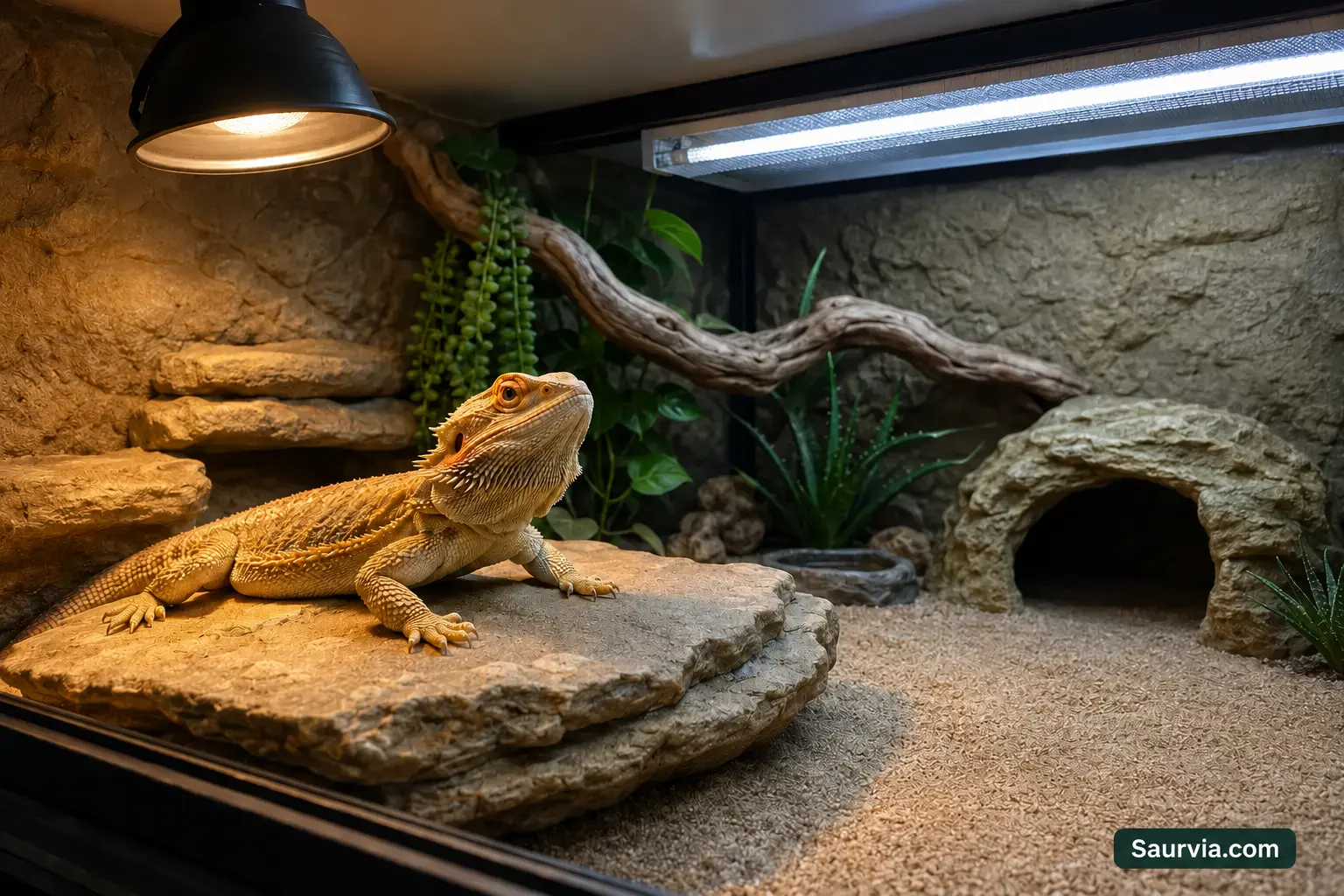
Current RSPCA guidance describes a hotter 38–42°C bright end and a cooler 22–26°C shaded end. It calls the stone in the hot end the basking zone and recommends an infrared thermometer at both ends, but it does not state unambiguously whether the 38–42°C range is a surface reading or local air temperature. Keep the numbers attached to that source wording instead of turning them into a universal target for every instrument. Merck's reptile-general table, by comparison, explicitly labels its values as air gradients and discusses basking temperature separately. [RSPCA] [Merck Veterinary Manual]
Build and control an accessible gradient, then keep separate records for the basking surface, warm-side air and cool-side air at animal height. Current RSPCA guidance also places the dragon's back 25–30 cm from the heat lamp and calls for a wire-mesh guard around the lamp. Keep that clearance attached to the cited installation rather than treating it as a universal distance for every heater. Record the heat source, guard, accessible clearance, instrument, location and time with each reading. A thermostat set-point and its probe location belong in the same log, but neither is a substitute for measuring the environment the animal can actually use. [RSPCA]
The evidence does not enter as one vote
Direct research
UVB, field diet, neonatal aggregation and recent enclosure studies answer narrow questions under declared conditions.
Professional guidance
Welfare and veterinary sources translate incomplete evidence into practical baselines, which must remain visibly attributed.
Keeper signals
Recurring disputes expose missing context and outdated habits; they do not establish safety, prevalence or causation.
This guide concerns a healthy captive Pogona vitticeps, not every animal called a “bearded dragon.” Sources were checked through August 15, 2026 under Saurvia's public methodology. Publication does not activate a care algorithm.
A detectable UVB reading is not necessarily an adequate one
In a juvenile experiment, UVB exposure produced a much stronger vitamin-D-metabolite response than dietary vitamin D3 under the tested conditions. A later study showed that previously exposed adult females retained metabolites for a limited period after exposure ceased. Together, the studies show a biologically consequential response to UVB. They do not make one bulb percentage, replacement date or supplement schedule universally correct. [Oonincx et al. 2010] [Oonincx et al. 2013]
A 2026 study followed 36 dragons enrolled at one month old under four daily supplement conditions, with or without artificial UVB. UVB exposure increased total and ionized calcium in the measured blood samples, while treatments did not change body weight or length. That result strengthens the evidence that UVB and supplements must be reviewed as one system; its limited outcomes do not establish a household supplement product or schedule. [Hetényi et al. 2026]
The practical starting point is more specific than “measurable UVB.” Current RSPCA guidance places a high-output 10–12% fluorescent tube over up to half the enclosure at the hot end, uses a correctly sized reflector and manufacturer-defined distance, and checks an animal-level gradient of UVI 3.0–5.0 at basking access to zero in shade. Some light-sensitive morphs may need a lower maximum. A weak reading is not adequate merely because a meter can detect it. [RSPCA]
Fixture output, distance, mesh or glass, reflector, usable coverage, posture and access to shade all alter exposure. Current RSPCA guidance also says UV lamps should be guarded when they are mounted where the dragon can contact them. Treat any guard or mesh as part of the measured geometry rather than assuming that the unobstructed lamp specification reaches the animal unchanged. Visible brightness cannot answer the question, and a replacement calendar cannot replace measurement. Record the geometry, measured UVI and every dietary or supplemental source of vitamin D3. Sufficient UVB is not a reason to stack unmeasured D3 products. [RSPCA]
The adult minimum is a prerequisite, not a complete habitat
The RSPCA currently recommends an enclosure measuring at least 120 cm long × 60 cm wide × 60 cm high for one adult. This is the practical minimum length, width and height used in this article. A well-furnished smaller enclosure is not equivalent. Once that prerequisite is met, the enclosure still needs a usable thermal and light gradient, secure retreats, climbing structure, digging opportunity and open locomotor space. [RSPCA]
Two 2025 studies sharpen this distinction. Crisante and colleagues reported increased activity, preference for enriched conditions and reductions in some stress-related behaviour in a twelve-animal crossover study. Denommé and colleagues found that naturalistic enclosures improved thermal heterogeneity, while the broader welfare signal remained equivocal. The label “naturalistic” is not the mechanism; the usable opportunities inside the enclosure are. [Crisante et al. 2025] [Denommé et al. 2025]
A wild diet snapshot cannot prescribe a household ratio
Researchers sampled 14 free-ranging dragons in one season. Flushing succeeded in 11, one sample was empty, and usable diet contents therefore came from ten animals. Those ten samples contained diverse arthropod and plant material, but they cannot prescribe a household ratio: a stomach-content snapshot does not establish long-term nutrient adequacy, energy density, food availability or life-stage needs. [Oonincx et al. 2015]
The absence of a universal ratio does not leave the diet undefined. The 2024 clinical review proposes at least half high-fibre plant matter, with varied invertebrates that have been gut-loaded and dusted with pure calcium. Current RSPCA guidance gives a different age-labelled implementation: about 65% livefood and 35% greens for young dragons, shifting to about 40% livefood and 60% greens above 30 cm. These are attributed starting points, not interchangeable proof of a universal 80/20 rule. [Barboza et al. 2024] [RSPCA]
Calcium and phosphorus remain part of the same plan. Reptile-general veterinary guidance treats a dietary calcium-to-phosphorus ratio of at least 1:1 as necessary and 2:1 as preferable, while emphasizing that common feeder insects are calcium-poor before gut-loading and dusting. Review the whole ration, UVB and every calcium/D3 product together instead of assuming that one percentage or one weekly schedule guarantees balance. [Merck Veterinary Manual]
Feeding frequency remains unsettled. Current RSPCA guidance says juveniles and adults should be fed once daily, while current VCA guidance says adults may eat every 24–72 hours. A 22-animal study suggested a two-to-three-day adult interval from post-meal blood chemistry, but every animal received one gavage meal after a 72-hour fast; this was not a long-term trial comparing feeding schedules or health outcomes. Do not average these sources into a new schedule. Record food offered and eaten, regular weight trend, activity and life stage, then review the individual plan with a reptile-experienced veterinarian. [RSPCA] [VCA] [Sosa-Higareda and Beaufrère 2025]
Hepatic lipid change is clinically material, but it does not supply a home body-condition rule. One retrospective study examined 571 dragons submitted for necropsy; a separate diagnostic study involved 14 dragons. Neither sample estimates prevalence in living household dragons, and neither validates a visual cutoff or remote diagnosis. Their useful public lesson is narrower: follow weight, intake and activity over time rather than treating one appearance or one measurement as clearance. [Barboza et al. 2023] [Barboza et al. 2023]
Substrate, housing and seasonal change need different decisions
Humidity, water and night temperature need named records too. Current RSPCA guidance proposes 30–40% relative humidity measured at the cool end, clean water in a large shallow dish at that end, and a night temperature that does not fall below 20–22°C. Merck's reptile-general Bearded Dragon table instead lists 20–30% humidity. Keep the source and location beside each number; do not average the ranges. Record when and where humidity was measured, the instrument, ventilation or condensation changes, and whether fresh water was available and changed. [RSPCA] [Merck Veterinary Manual]
Substrate begins with the animal's condition and the keeper's control of the enclosure. During quarantine, for juveniles, or when health, hydration, digestion or environmental control is uncertain, use an easily inspected non-particulate surface and provide digging only in a controlled box. For a healthy adult in a verified enclosure, current RSPCA guidance permits clean children's play sand or a sand/soil mixture; it also permits rough slate or tile when a separate digging opportunity is supplied. Avoid calci-sand, bark or wood chips, crushed walnut and corn-cob granules. [RSPCA]
The professional sources genuinely differ. A 2015 ARAV handout advises non-particulate flooring, while current RSPCA guidance permits defined loose substrates for healthy adults. A 529-patient retrospective series shows that gastrointestinal disease, constipation and sand ingestion were clinically material. It does not isolate loose substrate as the cause of every case. [ARAV 2015] [Schmidt-Ukaj et al. 2017]
Housing has a direct answer: one dragon per enclosure at every routine life stage. A current RSPCA welfare baseline supports separate housing. The neonatal aggregation experiment concerns neonatal thermoregulation, not household housing safety, while apparent tolerance supplies no controlled measure of competition, resource restriction or injury. [RSPCA] [Khan et al. 2010]
Separate housing does not remove reproductive planning for an adult female. Current RSPCA guidance says females may develop eggs without mating and should have access to a suitable digging box; repeated laying can draw heavily on calcium and energy reserves. Record whether sex is confirmed, whether a suitable laying site is continuously available, and any reproductive history alongside weight, intake, activity and digging behaviour. In a retrospective series drawn from 724 dragons and 1,000 veterinary visits, reproductive disease was a material part of the clinical record. That clinic sample does not estimate risk in household dragons or support home diagnosis, dosing or breeding advice. Repeated laying, difficulty laying or an unexplained change belongs with a reptile-experienced veterinarian. [RSPCA] [Sollom and Baron 2023]
Reduced appetite or inactivity is a different decision. RSPCA describes seasonal slowing and reduced intake but says a dragon should not lose weight or stop eating entirely; VCA advises veterinary assessment rather than assuming that lethargy or anorexia is brumation. VCA also recommends a veterinary examination before deliberate brumation is considered. In a retrospective series of 242 emergency presentations, lethargy and anorexia were associated with lower survival to discharge. That referral sample cannot diagnose a dragon at home or create a universal timing threshold, but it supports taking unexplained change seriously. Record weight trend, duration, intake, environment and accompanying changes, and involve a reptile-experienced veterinarian rather than relying on the calendar or starting a deliberate brumation plan without an examination. [RSPCA] [VCA] [Budas et al. 2026]
Eight debates that change when the measurement is restored
| Claim A | Claim B | Same measurement or context? | Evidence state | What remains unresolved |
|---|---|---|---|---|
| The lamp brand and replacement calendar tell us whether UVB is adequate. | Any UVB lamp is sufficient if the dragon can sit beneath it. | No. Output, distance, mesh, coverage, shade, animal-access height and lamp age all change exposure. | Current RSPCA guidance gives an actionable installation: a high-output 10–12% tube over up to half the enclosure, with a reflector and an animal-level gradient from UVI 3.0–5.0 at basking access to zero in shade. | Long-term outcome data that refine this source-attributed baseline across fixtures, morphs, distances and supplement exposure. |
| All loose substrate causes impaction. | A natural substrate is safe whenever the enclosure looks correct. | No. Material, health, hydration, feeding practice, temperature, hygiene and digging function alter the question. | A 2015 ARAV handout advises non-particulate surfaces, while current RSPCA guidance permits clean play sand or sand/soil for healthy adults and rejects calci-sand, bark, wood chips, crushed walnut and corn cob. The professional record is not a universal consensus for either slogan. | Comparative outcome data for defined substrate systems and animal states. |
| An 80/20 feeding ratio is the evidence-based formula. | Variety alone guarantees a complete diet. | No. Life stage, energy intake, food identity, nutrient composition, frequency and supplementation are missing. | The current clinical review supports at least half high-fibre plant matter, varied gut-loaded invertebrates and pure-calcium dusting, while RSPCA age bands differ from familiar 80/20 slogans. | Validated life-stage quantities, frequencies, total-ration nutrient targets and supplement exposure for companion animals. |
| Two dragons that appear bonded can share an enclosure. | A neonatal aggregation experiment proves social housing is natural. | No. Apparent tolerance and neonatal thermoregulation do not test adult competition, escape, injury or chronic resource restriction. | One dragon per enclosure is the routine welfare baseline at every life stage; a neonatal laboratory result does not create a household exception. | No routine companion-housing exception is supported by the checked evidence. |
| A 40-gallon enclosure is adequate because dragons have lived in one. | A larger box is automatically a better habitat. | No. Survival anecdotes and nominal volume omit internal dimensions, gradient quality, cover, climbing and usable choice. | Current RSPCA guidance specifies at least 120 × 60 × 60 cm for one adult. That space is a prerequisite; furnishing and gradient quality are additional requirements, not substitutes for a smaller enclosure. | Outcome-linked space requirements across life stages and enclosure designs. |
| A naturalistic enclosure is inherently higher welfare. | A simple enclosure is equivalent if temperatures are correct. | Not as labels. The animal experiences thermal options, cover, movement, digging and climbing—not the keeper's design category. | Recent studies found useful enrichment effects and improved thermal heterogeneity, while broader welfare results were mixed. | Which specific features produce durable welfare benefits, for which animals and over what period. |
| Reduced appetite and inactivity in a cooler season confirm brumation. | Any seasonal slowing has the same urgency and meaning. | No. Weight trend, duration, environment, food intake and accompanying changes are needed before the situations can even be compared. | RSPCA describes seasonal slowing and reduced intake but advises close weight monitoring and veterinary contact for weight loss; VCA advises veterinary evaluation rather than assuming that lethargy or anorexia is brumation. An emergency-referral series makes those signs clinically important without creating a household diagnostic threshold. | Validated household monitoring and referral thresholds that distinguish expected seasonal change from husbandry or health problems without remote diagnosis. |
| A female housed alone cannot develop eggs. | A general digging feature is always enough for laying. | No. Sex certainty, reproductive history, current trends and the suitability of a laying site all change the decision. | Current RSPCA guidance says a female can develop eggs without mating, needs a suitable digging box and can lose calcium and energy through repeated laying. A 724-animal veterinary-record series shows that reproductive disease was clinically material in the sampled practices, but it does not estimate household prevalence or define a home diagnostic threshold. | Validated household monitoring and referral thresholds, and a universally applicable laying-site specification for different enclosure systems. |
What to measure and build now
A useful enclosure record names what was measured, where, when and with which instrument. It records UVB geometry separately from heat, and environmental conditions separately from appetite, weight, feces and behaviour. That structure will not eliminate uncertainty, but it prevents different questions from collapsing into one reassuring number.
The current action baseline is concrete: build the RSPCA 38–42°C bright-end and 22–26°C cool-end proposal while recording surface, air and controller values separately; guard the heat lamp and preserve the source-specific 25–30 cm dragon-back clearance; provide measured UVB with UVI 3.0–5.0 at basking access and zero available in shade; guard a lamp mounted where the dragon can contact it, and count every guard or mesh layer in the geometry; use at least a 120 cm long × 60 cm wide × 60 cm high enclosure for one adult; track cool-end humidity, night temperature and fresh water; build a calcium-aware, varied, life-stage-aware feeding plan; choose substrate through the conservative health-and-control branch; house one dragon per enclosure; and include a suitable laying site and reproductive-context record for an adult female. Seek a veterinary examination before considering deliberate brumation. These are source-attributed public husbandry baselines. They do not become Assessment thresholds, a feeding schedule, a breeding protocol or an automated seasonal or reproductive decision merely because they appear here.