
“Beginner snake” is not a habitat specification
Calling a Corn Snake “beginner-friendly” may describe routine feeding or manageable handling. It says nothing about the length needed for full extension, the cover required by a hatchling or the conditions a fed snake should be able to select. Ease of entry is not a welfare specification.
The scope is a healthy, captive-bred Pantherophis guttatus with known identity and history. Hybrids, uncertain identification, wild-caught animals, breeding, deliberate brumation, force feeding and clinical cases are excluded. Sources were checked through July 26, 2026 under Saurvia's public methodology. The result is an evidence synthesis; no care algorithm is activated.
The source types answer different parts of the question
Direct research
Same-species studies examine space, enrichment and post-feeding physiology under declared conditions.
Professional guidance
Welfare and veterinary sources provide attributed household implementation baselines.
Keeper signals
Sampled disputes show where gallon labels, charts and seasonal explanations omit context.
Full extension is measurable; enclosure quality needs more
Current RSPCA guidance requires enough internal length for the snake to stretch fully, with width and height each at least one-third of body length. Its worked example is 150 × 50 × 50 cm for a 150 cm snake. That body-relative standard is more transparent than a gallon label, and it can be checked again as the animal grows. [RSPCA]
Hoehfurtner and colleagues tested twelve Corn Snakes in a crossover between enclosures two-thirds of body length and enclosures longer than the animal. In the larger condition, snakes were more active, could stretch fully and preferred the larger enclosure while active. The result supports the full-extension direction. It does not show that length alone makes every larger enclosure complete. [Hoehfurtner et al. 2021, space]
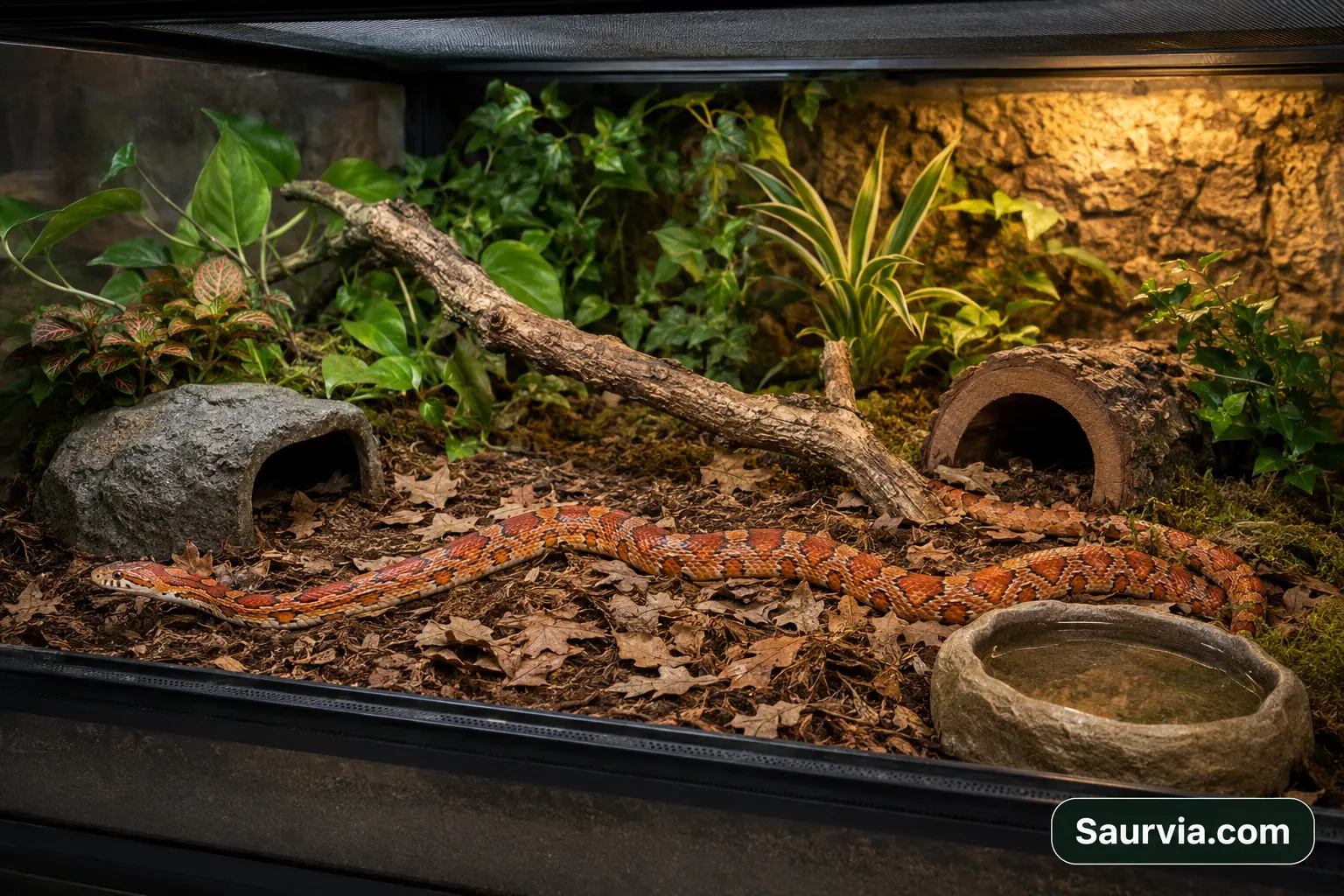
A terrestrial snake still uses vertical structure
A second same-species study found that Corn Snakes used enrichment and strongly preferred enriched housing. The study does not certify every object sold for a vivarium. It does undermine the claim that a water bowl and one hide exhaust the behavioural requirement. [Hoehfurtner et al. 2021, enrichment]
The RSPCA translates that direction into close-fitting hides at the warm and cool ends, additional cover, secure branches or platforms, burrowing opportunity and routes for exploration without constant exposure. For a hatchling, security matters alongside size. Use a staged enclosure or furnish a larger enclosure densely with small, confined spaces; an empty adult enclosure is not the alternative to a cramped box. [RSPCA]
Heat, humidity and UVB require separate records
For routine care, current RSPCA guidance gives a 28–30°C basking zone, a 20–24°C cool end and a night range of 16–20°C under normal household conditions. Use guarded, thermostatically controlled heat, but verify the result independently: thermostat set-point, probe reading, basking-zone air, surface peak and cool-side air are not the same measurement. [RSPCA]
Same-species physiology supports the need for choice. Fed juvenile Corn Snakes selected warmer substrate temperatures than unfed snakes in the tested gradients, while the metabolic cost of digestion peaked at 24 hours and returned to baseline by 72 hours. The experiment does not define a household basking threshold or universal handling timer. It supports access to thermal choice instead of one fixed temperature. [Sievert et al. 2013]
Humidity needs its own labels. The RSPCA gives about 40–50% ambient humidity and separately recommends a humid hide. A localized moist retreat is not an instruction to keep the whole enclosure wet. Record sensor position, daily range, ventilation, substrate moisture and condensation. Its current lighting proposal is also measurable: a low-output 2–7% UVB tube over roughly one-third to one-half of the enclosure, installed at the manufacturer's distance, producing UVI 1.0 at basking access to zero in shade. For some albino morphs it gives a maximum of 0.7. Packaging alone cannot establish exposure. [RSPCA]
A feeding chart starts the record; it does not finish it
Use appropriately sourced, pre-killed whole prey rather than exposing the snake to a live rodent's bite. Current RSPCA guidance starts hatchlings around one pinkie every five to six days and adults around one adult mouse every seven to fourteen days, with prey slightly wider than the widest body point. Those intervals are an attributed starting framework, not an instruction to ignore the individual. [RSPCA]
Record prey identity and size, feeding and refusal dates, regurgitation, weight and body trend. Acceptance alone cannot show that energy intake is appropriate. Repeated refusal, regurgitation, weight loss, injury or other concerning change belongs with a reptile-experienced veterinarian rather than repeated prey escalation or force feeding.
Check escape routes separately from seasonal change
A secure enclosure is a tested system, not a product label. Check doors, lid, vents, cable routes, latches and equipment penetrations after every change, and repeat the audit as the snake grows. House one Corn Snake per enclosure. Solitary housing also makes weight, feeding, feces, shedding and behaviour attributable to the correct animal. [RSPCA]
Seasonal slowing can occur, but the calendar cannot identify its cause. Do not begin deliberate brumation or manipulate heat and light from a forum label. Compare weight, duration, environmental records, life stage and accompanying signs. Unexplained change or weight loss needs veterinary assessment.
Seven debates, tested against the missing context
| Claim A | Claim B | Same measurement or context? | Evidence state | What remains unresolved |
|---|---|---|---|---|
| A gallon label tells us whether a Corn Snake enclosure is large enough. | Any enclosure longer than the snake is automatically adequate. | No. Nominal volume hides internal length, width and height; length alone also omits cover, usable vertical structure, thermal choice and security. | Current RSPCA guidance requires full extension plus width and height of at least one-third of body length. Same-species research supports the full-extension direction. | Outcome-linked dimensions across ages, body sizes, morphs and different furnishing densities. |
| Corn Snakes are terrestrial, so climbing structure is decorative. | Any natural-looking object counts as enrichment. | No. A label does not measure whether the snake can securely climb, hide, burrow, explore or choose among usable conditions. | Corn Snakes used and preferred enriched housing in a same-species study; the RSPCA also treats climbing, cover and multiple hides as functional requirements. | Which combinations and densities produce durable benefits for different individuals. |
| A large enclosure always stresses a hatchling. | A hatchling can be placed in an empty adult enclosure. | No. Size, visual exposure, hide fit, cover density, security and feeding history have been collapsed into one claim. | RSPCA guidance permits staged enclosure growth or a larger enclosure furnished with abundant, close-fitting confined spaces. | Controlled life-stage evidence separating enclosure size from cover and security. |
| The thermostat set-point is the basking temperature. | A single infrared reading proves the whole gradient is correct. | No. Set-point, probe position, basking-zone air, surface peak, cool-side air and night minimum answer different questions. | Current RSPCA guidance provides an actionable 28–30°C basking zone and 20–24°C cool end, with guarded thermostatic heat and independent measurement. | Outcome data refining surface, air, area and duration across enclosure designs. |
| Higher humidity during shed means the whole enclosure should be kept wet. | Corn Snakes are hardy, so humidity does not need measurement. | No. Ambient humidity, a localized humid hide, substrate wetness, ventilation and condensation are distinct conditions. | RSPCA guidance gives about 40–50% ambient humidity and a separate moist hide; persistent wetness is not the same intervention. | Standardized humidity cycles and microclimate measurements linked to shedding, skin and respiratory outcomes. |
| One feeding chart is correct for every Corn Snake. | If the snake accepts prey, the schedule is adequate. | No. Prey identity and size, age, body condition, weight trend, activity, season and health are missing. | Professional guidance supplies useful starting intervals and pre-killed whole-prey practice; longitudinal weight and body condition remain essential. | Validated body-condition criteria and individualized energy requirements for companion Corn Snakes. |
| Winter food refusal proves normal brumation. | Any seasonal slowdown proves disease. | No. Weight trend, duration, temperature, photoperiod, life stage, reproductive context and accompanying signs determine whether two cases are comparable. | Season may explain part of the pattern, but it cannot safely diagnose the cause. Unexplained change or weight loss needs a reptile-experienced veterinarian. | Reviewed non-diagnostic monitoring and referral boundaries for captive Corn Snakes. |
The attributed baseline before the snake arrives
The current practical baseline is direct: an escape-tested enclosure that permits full extension and provides at least one-third body length in width and height; close-fitting hides, cover, climbing and burrowing opportunities; guarded thermostatic heat verified at 28–30°C basking and 20–24°C cool access; about 40–50% ambient humidity plus a localized humid hide; measured UVI 1.0 at basking access to zero in shade; appropriate pre-killed whole prey with weight and body-condition records; and one snake per enclosure.
Each number remains attributed to the current source that supplies it. The values can guide planning without being recast as a validated universal formula. Publication does not activate a Corn Snake Assessment threshold.