
A familiar pet can still have a thin evidence base
Crested Gecko care is often presented as a settled recipe: room temperature, daily misting and powdered food. The literature is less complete. A direct thermoregulation study answers one part of the temperature question, while small studies address short-term growth, female dominance, novelty and tail function. Most household dimensions, humidity values and equipment choices still come from professional implementation guidance.
This guide concerns a healthy, captive-bred Correlophus ciliatus with known identity and history. It excludes breeding groups, owner-led assisted feeding, clinical care and diagnosis from appetite, shedding or posture alone. Sources were checked through July 28, 2026 under Saurvia's public methodology.
Three source roles keep a practical number in its proper place
Direct research
Same-species studies test defined thermal, feeding, social, novelty and tail outcomes in limited samples.
Professional guidance
Veterinary and welfare sheets supply household baselines, but their dates, measurements and disagreements remain visible.
Keeper signals
Sampled discussions locate disputes around juvenile space, handling and cohabitation. They do not prove frequency or cause.
Preferred temperature is not the same as peak sprint temperature
Aparicio Ramirez, Perez and Telemeco measured adults and juveniles on a laboratory gradient. The geckos actively maintained a narrow thermal set-point of 24–28°C during activity. Their modeled optimum for running performance was higher, around 32°C, and close to an average voluntary maximum near 33°C. That does not make 32°C a routine enclosure target. Preference, a short locomotor test and sustained household exposure are different outcomes. [Aparicio Ramirez et al. 2021]
Current Royal Veterinary College guidance supplies the practical starting architecture: guarded thermostatic heat, an approximately 28°C basking area, cool access around 25°C and control preventing the night temperature from falling below about 20°C. Verify the result with independent maximum/minimum thermometry. A room thermostat, heat-source setting and upper-perch reading do not substitute for one another. [RVC 2024]
Usable height is a network of routes, retreats and resting support
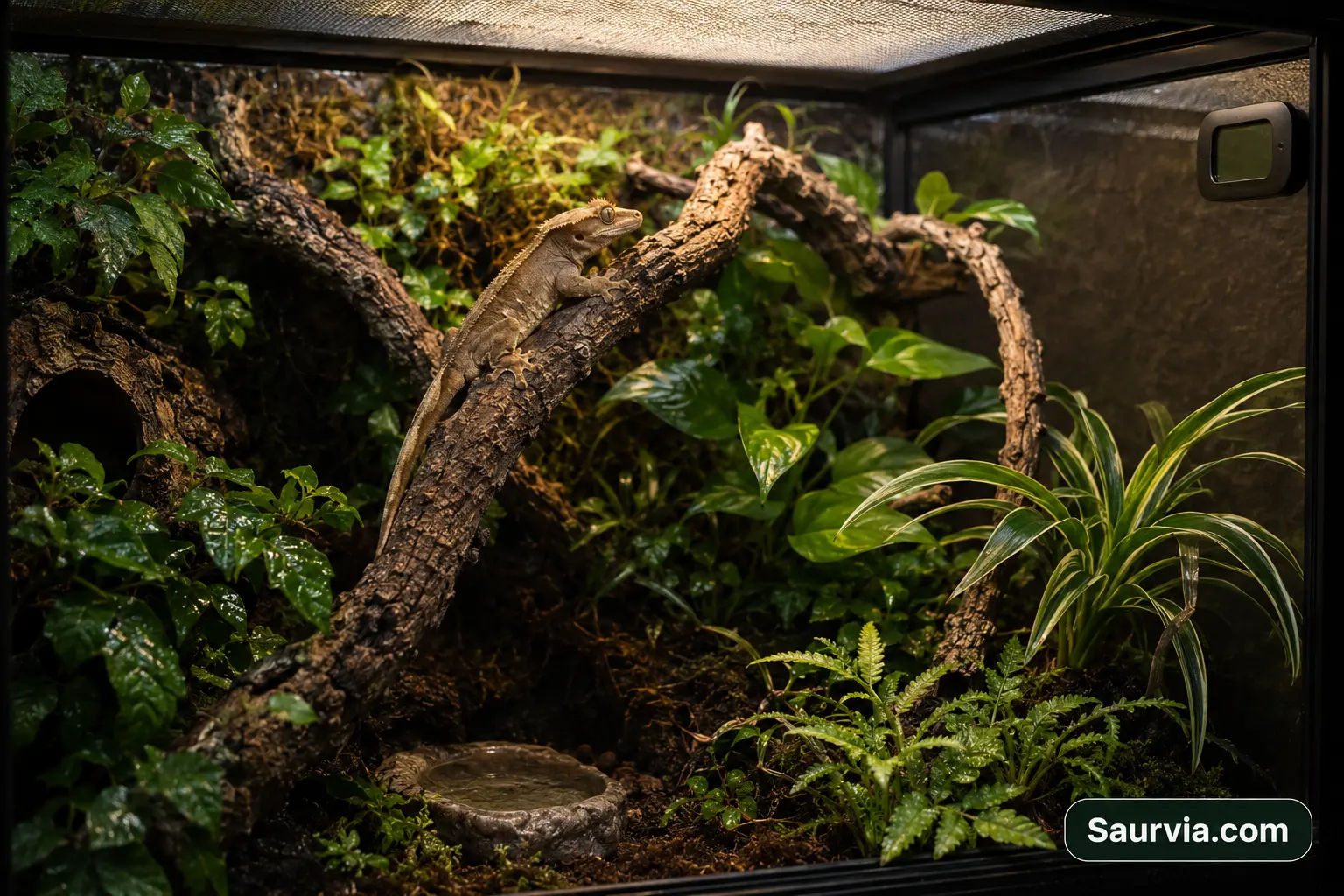
Both reviewed professional guides set 45 × 45 × 60 cm as the minimum internal enclosure size for one adult. Do not plan below that floor. The RVC also advises providing as large a vivarium as possible, but additional volume is useful only when it remains secure and properly furnished. Height becomes usable only when stable branches, vines and foliage connect feeding, warm, cool, humid, shaded and open locations. Include horizontal and diagonal resting support rather than forcing the gecko to cling to glass for every elevated rest. [RVC 2024] [RSPCA 2015]
A small 2023 study involving ten adult Crested Geckos found substantial individual variation in interaction with novel objects and fecal glucocorticoid metabolites. It does not certify a favorite color or object. It supports observing the individual and changing one feature at a time, rather than assuming that decorative novelty is automatically enrichment. [Fernández-Lázaro et al. 2023]
Choose substrate for the animal, the moisture cycle and what you can monitor
The RSPCA describes coconut fibre or a suitably mixed soil substrate covered with moss or leaves as humidity-holding options. A naturalistic or bioactive floor is not automatically safe merely because it carries that label: its components, drainage, moisture, cleanliness and risk of ingestion still need to be known. Plain paper is a practical temporary surface during quarantine, illness or close monitoring because feces and intake-related debris remain visible. [RSPCA 2015] [RVC 2024]
Avoid calcium sand, crushed walnut and other coarse or readily swallowed particles, as well as dry dusty material and persistently waterlogged or moulding substrate. The ingestion warning is a general reptile safety principle rather than a Crested Gecko outcome study. Feed insects from a controlled surface or cup when loose material could be taken with the prey. Substrate choice does not compensate for poor ventilation, an absent dry-back period or an animal showing abnormal appetite, feces, breathing or shedding. [RSPCA reptile substrate guidance]
Humidity advice disagrees until time and sensor position are restored
The current RVC sheet gives 50–70% relative humidity. The older RSPCA sheet gives 40–50% with temporary boosts to 60–80%, while explicitly requiring the enclosure to dry between misting. Those statements cannot be compared as one number unless the sensor position, time after misting, ventilation and substrate condition are known. [RVC 2024] [RSPCA 2015]
Keep a clean water dish, good cross-ventilation and a localized humid retreat. Record a pre-mist reading, post-mist peak and return toward the drier part of the cycle at a named sensor location. Also record condensation and substrate saturation. A high air reading, waterlogged substrate and a humid hide are not interchangeable exposures. Persistent shedding difficulty, abnormal breathing or another concerning change belongs with a reptile-experienced veterinarian, not increasingly wet trial-and-error.
Five weeks of weight gain cannot establish lifetime nutritional adequacy
A 2024 trial randomized 60 related juveniles to one commercial formula or to calcium-dusted Dubia roaches plus papaya for five weeks. Both groups gained length and weight. The insect-and-papaya group gained more weight, while length and observed activity did not differ. The study tested one formula, one mixed regimen and a short growth window. It did not measure long-term skeletal health, body composition, reproduction or lifespan. [Brundage et al. 2024]
Current RVC guidance begins with a complete formulated Crested Gecko diet and also describes a defined fruit-and-vegetable mixture with gut-loaded, supplemented invertebrates. The older RSPCA sheet instead treats commercial diet as supplementary. That dated contradiction should not be hidden, and the short trial cannot settle it. For routine planning, a product represented as complete and used exactly as directed is the more traceable base; record the actual product, preparation, offers, intake, insects, weight and body trend. Do not improvise extra supplements or switch regimens to chase rapid weight gain. [RVC 2024] [RSPCA 2015]
Individual housing avoids turning a small social study into a gamble
The older RSPCA sheet says single housing is best but conditionally permits female groups with duplicate resources and monitoring. A 2020 meeting abstract observed two cohorts of three cohabited females for 60 days and reported one dominant and two submissive animals in each cohort. Six animals cannot estimate how often dominance occurs, and the report does not validate a safe group size or enclosure formula. [Schaefer et al. 2020] [RSPCA 2015]
House one Crested Gecko per enclosure outside a controlled breeding context. That safeguard prevents unseen competition for food, retreats and preferred perches, and keeps weight, intake, feces, shedding and behavior attributable to the correct animal. Absence of biting is not evidence that access and outcomes are equal.
Low-output UVB, an intact tail and voluntary handling need separate claims
The RVC proposes a low-output UVB lamp, such as 6%, for about twelve hours at the manufacturer's distance. That is professional guidance, not a same-species dose-response study. Lamp percentage does not state what reaches the gecko after distance, mesh and foliage. The UV-Tool places Crested Geckos in Ferguson Zone 1: background exposure of 0–0.7 UVI, with a reported maximum range of 0.6–1.4. Those bands help design and measure a low-exposure gradient; they are not evidence that every animal requires a fixed 0.5–1.5 UVI basking target. Measure at the nearest usable perch, respect the lamp's minimum safe distance, and provide foliage and complete shade down to zero exposure. [RVC 2024] [Baines et al. 2016]
The intact tail is not disposable decoration. Griffing and colleagues found a specialized adhesive pad with substantial attachment performance. The research does not prescribe handling, but it reinforces the practical boundary in both care sheets: never grasp the tail. Let the gecko step onto a hand voluntarily, work low and close to a secure surface, and stop when the animal is trying to flee. A dropped tail does not regenerate. [Griffing et al. 2021] [RVC 2024]
Eight familiar claims after the missing measurement is restored
| Claim A | Claim B | Same measurement or context? | Evidence state | What remains unresolved |
|---|---|---|---|---|
| Normal room temperature is automatically suitable. | Crested Geckos need one uniformly warm enclosure. | No. Room air, upper-perch air, surface temperature, night minimum and the animal's chosen body temperature are different measurements. | A same-species laboratory study found active thermoregulation within a 24–28°C set-point range. Current RVC guidance uses an approximately 28°C basking area, about 25°C cool access and a controlled night floor near 20°C. | Household outcome data across enclosure geometry, seasons, age, reproductive state and sustained exposure. |
| The 32°C sprint optimum is the correct basking target. | A gecko choosing 24–28°C cannot perform well. | No. A modeled peak for short running performance is not the same outcome as preferred temperature, daily exposure or long-term health. | The direct study separated a 24–28°C preferred set-point from a roughly 32°C performance optimum and an average voluntary maximum near 33°C. | Long-duration physiological and welfare outcomes at specific captive temperatures. |
| Humidity should stay at 50–70% continuously. | Humidity should sit at 40–50% except for misting spikes. | Not without sensor location and time. Ambient air, post-misting peak, dry-out point, humid retreat, substrate moisture and condensation are different exposures. | The 2024 RVC sheet gives 50–70%; the older RSPCA sheet gives 40–50% with temporary boosts to 60–80% and an explicit dry-out period. | Sensor-defined daily cycles tied to shedding, hydration, skin and respiratory outcomes. |
| A complete formulated diet needs no further scrutiny. | Greater five-week weight gain proves insects and papaya are superior. | No. Product formulation, intake, growth rate, body composition, skeletal health, reproduction and long-term adequacy were not the same outcomes. | Current RVC guidance begins with a complete formulated diet. One five-week juvenile trial found greater weight gain on its insect-and-papaya regimen, with no group difference in length or observed activity. | Independent long-term comparisons of complete formulations and defined mixed diets across life stages. |
| A 45 × 45 × 60 cm label completes the enclosure. | Any taller enclosure supplies arboreal space. | No. Internal dimensions do not show branch connectivity, horizontal resting support, foliage, retreat access, feeding access or usable gradients. | RVC and RSPCA guidance set 45 × 45 × 60 cm as the adult minimum while still requiring climbing, cover, hides, ventilation and thermal choice. | Same-species space and furnishing studies linked to locomotion, rest, injury and preference. |
| Female Crested Geckos can safely live together. | Visible fighting is the only sign that a group is failing. | No. Food access, retreat access, weight trend, displacement and chronic avoidance can differ before an obvious fight is observed. | An older RSPCA sheet conditionally allows female groups, while a small 60-day report found a dominant female in each of two three-female cohorts. | Adequately powered studies of group composition, resources, individual outcomes and delayed effects. |
| Nocturnal means UVB is useless. | A lamp marked 6% proves useful exposure. | No. Activity timing, lamp percentage, distance, mesh, foliage, available UVI and access to complete shade are not interchangeable. | RVC guidance proposes low-output UVB. The UV-Tool assigns this species to Ferguson Zone 1, whose background range is 0–0.7 UVI with a reported maximum range of 0.6–1.4; these are exposure bands, not a proven same-species clinical target. | Measured same-species UVB exposure linked to calcium metabolism, behavior and long-term outcomes. |
| A dropped tail grows back. | Tail loss is cosmetic, so tail handling is harmless. | No. Regrowth, the mechanics of the intact tail and the cause of loss are separate questions. | Professional guidance states that the tail does not regenerate. Direct research shows the intact tail has a specialized adhesive pad and meaningful climbing function. | Handling and enclosure factors that alter autotomy risk and long-term functional outcomes. |
What should be working before the gecko arrives
The current attributed planning baseline is one Crested Gecko in a secure, well-ventilated arboreal enclosure that does not begin below 45 × 45 × 60 cm internal for an adult, with more space when it can be securely and usefully furnished; connected branches, horizontal rests, foliage and shaded retreats; guarded thermostatic heat independently checked at about 28°C basking and about 25°C cool access, with a controlled night floor near 20°C; a named-location humidity record that captures both misting peaks and dry-back rather than one unlabeled value; clean water, a humid retreat and a substrate whose moisture, cleanliness and ingestion risk can be managed; measured Zone 1 UVB with a gradient to complete shade; a traceable complete formulated diet as the routine base, with any invertebrates and supplements recorded; and tail-safe, voluntary handling.
The enclosure and environmental numbers remain attributed to current RVC and older RSPCA guidance. Direct research supports active thermal choice, limits the interpretation of a short feeding trial, identifies dominance in a very small female sample, and shows that the tail is functional. None of it validates a universal formula.
The next useful studies have narrower, testable jobs
Space research should separate enclosure dimensions from branch connectivity and cover. Humidity work needs named sensor positions, daily cycles, ventilation and clinical outcomes. Nutrition needs independent, long-term comparisons of defined complete formulations and mixed diets. Social studies need enough individually identified animals to measure access, weight, displacement and delayed outcomes. UVB studies need measured exposure rather than lamp labels. Those designs could change this guide; additional unsourced certainty could not.