
This is a species evidence guide, not a copied care sheet
This guide addresses a healthy, captive-bred Gargoyle Gecko with known identity and history. It does not cover breeding, incubation, diagnosis, treatment, force feeding or deliberate seasonal cycling. If identity, origin, age, sex, reproductive status or health is uncertain, those unknowns should remain visible rather than be silently replaced with a standard profile.
The central problem is not a complete absence of evidence. It is that different sources answer different questions. Direct field studies describe where animals perched and what some had eaten. A peer-reviewed UV tool proposes an exposure category. Welfare and care guides propose household systems. None of those sources, alone or together, is a controlled lifetime trial of captive Gargoyle Gecko care.
Evidence position: source-bounded planning is possible now. Numeric thresholds and automated conclusions remain under assessment.
Research, guidance and keeper reports have different jobs
Research evidence
Peer-reviewed field, diet, lighting-framework and clinical papers answer bounded questions. Applicability still depends on design and context.
Professional guidance
Veterinary, welfare and specialist sources offer implementable proposals. Their numbers remain attributed when outcomes have not validated them.
Keeper signals
Sampled discussions reveal confusion about heat, diet and cohabitation. They do not measure prevalence or settle the dispute.
Saurvia synthesis
Saurvia compares source roles, preserves contradictions and maps useful meanings to draft Assessment artifacts. It creates no new evidence.
Separating these roles prevents a wild perch from becoming an enclosure minimum, a stomach item from becoming a captive menu, a working UV category from becoming a clinical outcome and an anecdote from becoming a safety claim. It also prevents “the evidence is limited” from becoming an excuse to ignore measurable enclosure function.
The direct field record supports arboreal opportunity—not one enclosure formula
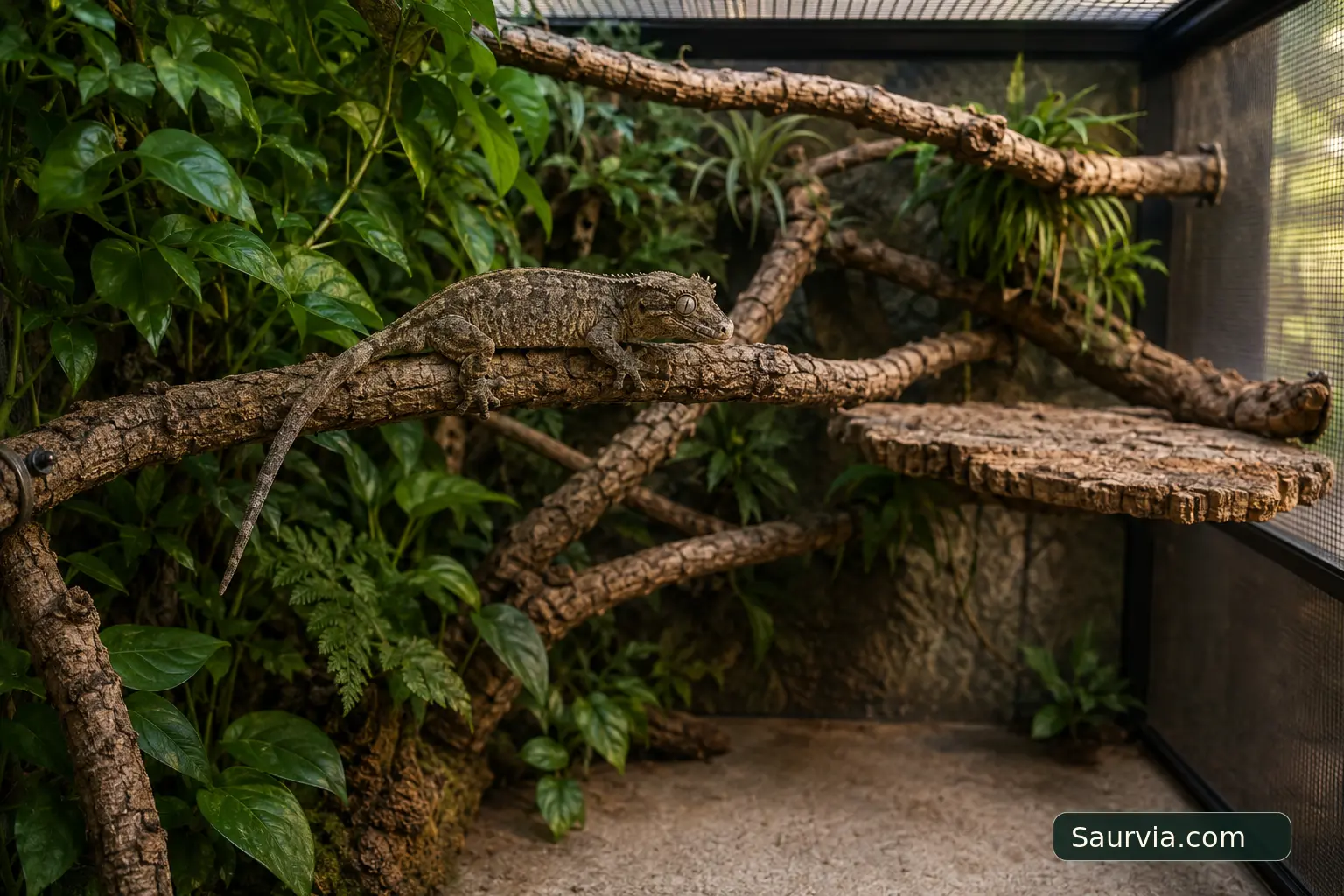
Snyder and colleagues surveyed southern New Caledonia for 30 nights during June to August 2004. They reported 102 captures representing 88 individuals: 13 captures in humid forest and 89 in maquis. Every animal was on a tree or shrub. Mean perch height was 1.6 ± 0.8 m in forest and 1.8 ± 1.1 m in maquis. Females, males and juveniles differed modestly in recorded perch height, and heavier animals tended to occur higher. These observations make arboreal access and multiple usable levels biologically relevant. They do not define a minimum glass-tank dimension. [Snyder et al. 2010]
Captures were greatest one to four hours after sunset, but search effort was productive and non-random. The authors therefore could not turn capture time into a population-wide activity peak. Start-of-night temperatures ranged from 14.3°C to 21.9°C without a significant relationship to hourly capture rate. That does not prove those temperatures are captive targets or that temperature is unimportant; it shows why field availability and preference are different questions. [Snyder et al. 2010]
Audit usable routes before arguing about a tank label
The Federation of British Herpetologists places Gargoyle Geckos in its arboreal Gecko Group 2 and proposes an enclosure relationship of 4 × 4 × 5 snout–vent lengths. ReptiFiles proposes 12 × 12 × 12 inches below 12 g and 18 × 18 × 36 inches above 12 g. These are professional planning proposals, not two replications of the same outcome study. Saurvia does not average them or turn the 12 g transition into a biological cutoff. [FBH 2023] [ReptiFiles]
A useful pre-arrival audit records internal width, depth and height, then checks what the gecko can actually do. Are there sturdy connected routes in more than one orientation? Are resting sites available at different levels and exposures? Can the animal reach water, food, cover and environmental choices without crossing an unsupported gap? Are branches and heavy décor secured, and are likely landing areas safe? Can the keeper still observe intake, feces, shed and body condition? Nominal volume and foliage percentage cannot answer those questions.
Temperature needs a place, surface and duration
The UV Tool’s species table proposes a 29°C basking surface, daytime air of 25–29°C and night air of 20–25°C. ReptiFiles repeats much of that framework and adds a cooler-zone proposal. These values are useful as attributed hypotheses for expert review; they are not direct Gargoyle Gecko exposure-outcome thresholds. [Baines et al. 2016] [ReptiFiles]
Before an animal arrives, measure accessible top, middle and lower air and relevant resting surfaces through the daily cycle. Record instrument type, probe position, maximum duration, room baseline and season. Any added heat should be guarded where contact is possible and controlled independently of the display thermometer. General reptile veterinary guidance supports a gradient and thermostatic control; it does not make one controller set point a measurement of the animal’s exposure. [Merck Veterinary Manual]
Humidity is a cycle inside a ventilated water system
ReptiFiles proposes an average relative humidity of 50–70%, with a temporary rise after misting and subsequent dry-out. The numbers remain that source’s proposal because no same-species controlled outcome study validates one universal cycle. A defensible plan still needs drinking access, a known sensor location, peak, duration, trough, ventilation, drainage and a way to detect saturated substrate or persistent condensation. [ReptiFiles]
General veterinary guidance warns against restricting ventilation simply to retain humidity because stagnant, persistently wet conditions can create skin and respiratory risk. That safeguard does not support keeping the enclosure dry; it supports treating air exchange, surface moisture, substrate water and drinking as connected but distinct variables. [Merck Veterinary Manual]
The Zone 1 versus Zone 2 conflict should remain visible
The original peer-reviewed UV Tool explicitly lists R. auriculatus in Ferguson Zone 2. Its general Zone 2 band is a background UVI of 0.7–1.0 and a maximum of 1.1–3.0. ReptiFiles labels the species Zone 1 while proposing UVI 1–2. That is not a harmless wording difference: the source label conflicts even though the proposed range overlaps part of Zone 2. Saurvia therefore records the disagreement instead of choosing a label by repetition. [Baines et al. 2016] [ReptiFiles]
The UV Tool is itself a working guide: assignments use field studies where possible and inferred captive behaviour where necessary. A responsible lighting review must examine animal-level UVI at the accessible perch, distance, mesh, reflector, lamp age, shade, voluntary exposure and how diet and supplements contribute vitamin D. A bulb percentage or zone label alone is not an exposure measurement, and this article activates no UVI score.
Wild dietary breadth is not a captive menu
Bauer and Sadlier found food in 19 of 21 preserved specimens. Arthropods dominated the identified animal material; skink remains occurred in five guts, while plant material occurred in three and stamens or anthers in two. Snyder and colleagues later recovered food from 14 of 66 stomach-flushed animals during the austral winter sample; 15 of 18 recovered items were animal material and 13 were arthropods. These studies show broad wild consumption, not a balanced captive recipe. [Bauer & Sadlier 1994] [Snyder et al. 2010]
A household plan should identify the exact prepared formulation and verify whether it is represented as complete when mixed and used as directed. It should record preparation, storage, replacement, actual intake, any insect species and size, feeder care, supplements and weight/body-condition trends. Brand popularity and bowl acceptance do not demonstrate nutritional completeness. Conversely, lizard remains in wild stomachs do not justify feeding pinkie mice or other vertebrates. This guide gives no vertebrate-prey recommendation. [ReptiFiles proposal under review] [Stahl 2010]
Perch partitioning is not evidence of social benefit
In the field sample, females and males were recorded somewhat higher than juveniles, and the authors suggested that spatial or temporal partitioning could reduce aggressive encounters. That is a plausible ecological interpretation—not a captive cohabitation experiment. It cannot show that two animals benefit from sharing an enclosure or that both have equal access to food, water, preferred perches, shade and retreat. [Snyder et al. 2010]
General veterinary guidance notes that solitary housing is often the healthiest arrangement for reptiles because it prevents competition and aggression. Saurvia therefore uses one gecko per enclosure as the conservative planning position while species-specific review remains open. Breeding introductions and veterinary isolation are separate workflows, not exceptions a general readiness result should improvise. [Merck Veterinary Manual] [keeper discussion sample]
Regeneration changes the biology, not the prevention duty
Snyder and colleagues recorded whether captured animals had original or regenerated tails and illustrated a regenerated, patternless tail. That is direct same-species evidence that regeneration occurs. The study does not establish that autotomy is harmless, predict how an individual will recover or supply a home wound-treatment protocol. [Snyder et al. 2010]
Handling should be voluntary where possible, supported close to a safe surface and free of tail traction. Enclosure doors, gaps, heavy décor and cohabitation are also tail-safety issues. A regenerated tail is a history observation, not proof of present illness or neglect. Fresh injury, persistent bleeding, swelling, discharge, loss of function or systemic change belongs with a reptile-experienced veterinarian, not an online visual diagnosis.
Trend records improve decisions without pretending to diagnose
Record body weight with the same scale and method, actual food intake, feces, activity, shed and toe condition, skin, breathing, posture and tail changes. Context matters: arrival, a formulation change, equipment change, season, reproductive status and recent handling can alter interpretation. A single missed meal or one weight reading does not identify a disease.
Prompt veterinary assessment is appropriate when decline is sustained or combined with marked lethargy, breathing difficulty, neurologic change, trauma, persistent vomiting/regurgitation, severe diarrhea, abnormal oral tissue, significant swelling or discharge. The ovarian-torsion case series included one adult female Gargoyle Gecko with acute weakness and coelomic distension; that narrow record reinforces urgent referral in such a context but does not make ovarian torsion common or remotely diagnosable. [Merck Veterinary Manual] [Paillusseau et al. 2024]
What can be planned now—and what cannot
| Topic | Measure or verify now | Source-attributed proposal | Not established |
|---|---|---|---|
| Space | Internal dimensions; stable travel/rest routes; cover; feeding; landing; observation. | FBH 4 × 4 × 5 SVL; ReptiFiles 18 × 18 × 36 in after 12 g. | A universal minimum or validated 12 g transition. |
| Heat | Accessible air/surfaces by location and time; source; thermostat; probe; guard. | UV Tool and ReptiFiles publish bounded temperature proposals. | A direct same-species preferred range or outcome threshold. |
| Moisture | Drinking; sensor location; peak/duration/trough; airflow; drainage; saturation. | ReptiFiles proposes a 50–70% average with a temporary peak and dry-out. | One universal percentage or automatic misting response. |
| UVB | Animal-level UVI geometry, shade, mesh, lamp age, diet and supplements. | UV Tool Zone 2; ReptiFiles Zone 1 and UVI 1–2. | A resolved zone, fixture percentage or active score. |
| Diet | Exact formulation, preparation, freshness, intake, insects, supplements and trends. | Professional sources propose prepared diets plus varying insect systems. | A validated brand, schedule, insect frequency or vertebrate need. |
| Housing | One animal per enclosure; handling and tail-safety plan. | General veterinary guidance supports solitary housing. | Social benefit or a safe pair/group formula. |
Eight contradictions the evidence does not permit us to hide
The table compares claims only when their measurement and context are made explicit. “Unresolved” is not a verdict that every option is equally safe; it identifies the next evidence or expert decision required before an automated rule could be activated.
| Claim A | Claim B | Same measurement or context? | Evidence state | What remains unresolved |
|---|---|---|---|---|
| A Gargoyle Gecko can use Crested Gecko care values because both are New Caledonian arboreal geckos. | Every value must be completely different because the species are different. | Neither shortcut is justified. Related species can generate useful questions, but each transferred value still needs its own source and applicability check. | Same-species field studies describe Gargoyle Gecko perch use and diet. Direct captive-outcome evidence remains sparse. | Controlled same-species studies of long-term housing, thermal, lighting and nutrition systems. |
| Normal room temperature means no heat or measurement is needed. | A lamp or thermostat set point proves the correct temperature is available. | No. Room air, top-zone air, accessible surfaces, device settings and exposure duration are different measurements. | The UV Tool and current care guidance offer attributed thermal proposals; general veterinary guidance requires measured choice and controlled equipment. | Same-species preferred-temperature and outcome evidence across season, life stage and enclosure geometry. |
| One humidity percentage defines a safe enclosure. | A dry period means drinking access and moisture management do not matter. | No. Sensor position, peak, duration, trough, ventilation, drainage, substrate water and drinking are separate variables. | Professional sources propose moisture cycles; direct captive outcome thresholds are absent. | Measured cycles linked to hydration, shedding, skin, respiratory and behavioural outcomes. |
| A prepared gecko diet is complete because the animal eats it. | Wild lizard remains mean captive Gargoyle Geckos should be offered vertebrate prey. | No. Palatability, formulated completeness, wild consumption and captive welfare are different claims. | Two same-species studies document broad wild consumption, mostly animal material in the recovered samples, plus plant material. They test no captive formula. | Long-term same-species outcomes for identified complete formulations, insects and supplementation systems. |
| A fixed tank label or foliage percentage proves adequate space. | Any tall enclosure is adequate because the species is arboreal. | No. Internal dimensions and functional routes, rest, cover, feeding, landing, observation and environmental geometry must be examined together. | Field animals were found on trees and shrubs. FBH and ReptiFiles publish different planning proposals, neither validated as a universal outcome threshold. | Space-use and welfare outcomes across body size, route design and enclosure dimensions. |
| Perch separation in the wild shows Gargoyle Geckos benefit from company. | A conflict-free pair proves captive cohabitation is safe. | No. An observational association and absence of visible conflict do not measure equal resource access, chronic competition or social benefit. | The field authors hypothesized that perch partitioning might reduce aggressive encounters; they did not test captive cohabitation. | Validated welfare outcomes and any legitimate temporary exception to individual housing. |
| The species belongs to Ferguson Zone 1. | The species belongs to Ferguson Zone 2. | Yes—the labels address the same species, but the sources conflict. The original UV Tool says Zone 2; ReptiFiles says Zone 1 while proposing UVI 1–2. | The primary peer-reviewed tool is a working inference framework, not a same-species outcome trial. The secondary guide does not resolve the discrepancy. | Animal-level exposure outcomes and an expert review of geometry, shade, diet and supplementation. |
| Tail loss is minor because this species can regenerate its tail. | Any regenerated tail proves previous neglect or current illness. | No. Regeneration confirms biological capability; it neither makes loss harmless nor diagnoses its cause. | The same-species field study records original and regenerated tails and illustrates a regenerated form. | Quantified welfare cost, recovery outcomes and validated household referral criteria. |
How this research enters Assessment
The final synthesis has been mapped to non-active assertions, Knowledge Cells, resolving questions and conditional branches covering identity, usable arboreal space, thermal measurement, water balance, UVB conflict, diet formulation, wild-to-captive prey transfer, individual housing, tail safety, records and referral access. This prevents the article from becoming an isolated publication.
Publication does not make any source number an active score. Expert disposition, benchmark behaviour, safety review, text review, versioning and an approved effective record are still required. Until then, the research can improve what the future system asks without pretending that an unresolved source conflict has been solved.
Evidence that would materially change this guide
- Same-species space-use and welfare outcomes across defined internal dimensions, route structures and life stages.
- Preferred-temperature and long-duration health outcomes measured at animal-accessible air and surfaces.
- Controlled moisture-cycle and ventilation studies with hydration, shed, skin, respiratory and behavioural outcomes.
- Animal-level UV exposure studies that report geometry, shade, diet, supplementation and clinically relevant outcomes.
- Long-term nutrition trials of identified complete formulations, insects and supplementation systems.
- Welfare research that tests individual housing against any proposed social arrangement without relying only on visible fighting.