
Start with a setup you can verify
A beginner needs more than a warning that “context matters.” They need to know what to buy, where to measure it and which details must stay connected. The baseline below applies to one healthy, captive-bred, nonbreeding Leopard Gecko. A new arrival, an unwell animal or an animal of uncertain origin needs a more conservative branch and a reptile-experienced veterinarian.
The numbers are source-attributed planning references, not biological cliffs. Where two professional sources use different measurement language, this guide keeps both visible instead of averaging them into a false consensus.
Practical baseline for one Leopard Gecko
| Area | Plan now | Verify in use | Boundary |
|---|---|---|---|
| Adult space | Use 36 × 18 × 18 inches as the conservative adult planning floor, with one gecko per enclosure. | Warm, cool and humid refuges; cover; stable low climbing; movement routes; feeding access; secure closure. | A larger barren enclosure is not enrichment. |
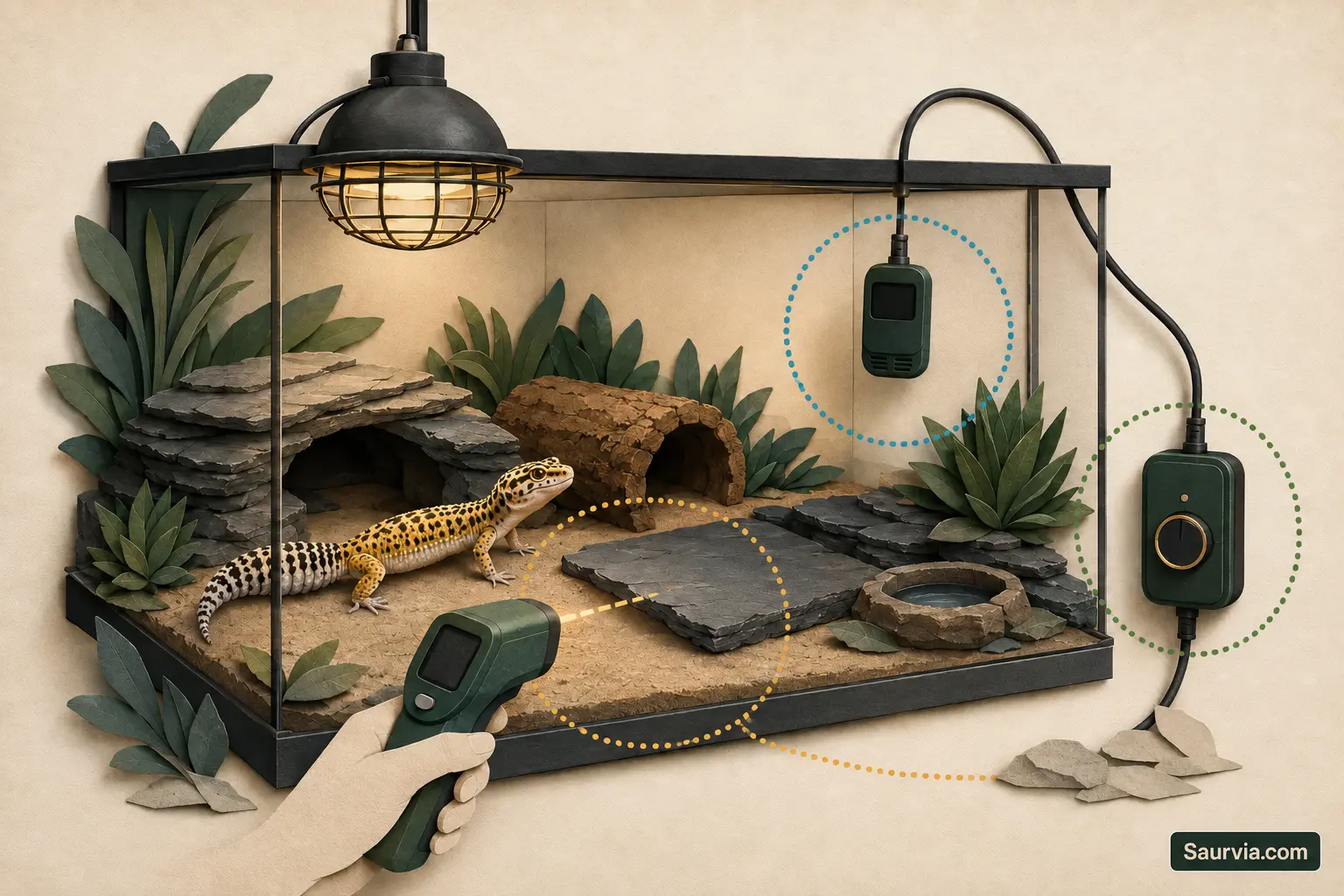
| Daytime heat | Guarded, thermostat-controlled overhead heat at one end. RSPCA: 28–30°C basking zone and 24–26°C cool end. RVC: about 32°C basking area and 25°C cool end. | Surface temperature with an infrared thermometer and positioned air readings with digital probes; record the controller setting separately. | Do not merge source terms or infer animal exposure from the thermostat display. |
| UVB and shade | Low-level UVB across part of the enclosure. The RSPCA proposes about UVI 0.7 at the basking area grading to zero in shade. | Animal-level UVI, lamp distance and age, mesh, accessible shade and the complete dietary supplement inventory. | Lamp percentage is not UVI, and UVB does not create a universal D3 schedule. |
| Humidity and shedding | Keep cool-end ambient humidity around 30–40% and provide an enclosed humid hide containing damp moss or paper at all times. | Sensor location, hide moisture, ventilation, toes, tail tip and skin around the eyes after shedding. | A humid hide is a localized microclimate, not permission to keep the enclosure wet. |
| Food and supplements | Offer a varied staple of live invertebrates, gut-loaded for 24–48 hours, plus fresh water and a defined reptile calcium/multivitamin system. | Feeder identity and size, offered versus eaten, gut-load, every supplement label and frequency, weight, feces and body trend. | Fruit-based Crested Gecko diets are not a substitute, and supplement products must not be stacked casually. |
| Substrate | Use an easy-clean non-loose surface for young, newly arrived, unwell or uncertain animals. For a healthy adult in a stable setup, the RSPCA permits an approximately 50:50 organic-soil and play-sand mix. | Material identity, feeding method, ingestion exposure, heat, hydration, appetite, weight and droppings. | Never use calcisand, beech chips or other named non-natural loose substrates. |
These references come from current RVC and RSPCA guidance. [RVC 2022] [RSPCA current guidance]
Why the sources do not all answer the same question
Direct and clinical studies
Same-species UVB, vitamin-A, enrichment and parasite records answer bounded biological or clinical questions. They are not complete household-care protocols.
Professional guidance
RVC, RSPCA and Merck translate a broader evidence base into care, quarantine and referral practice. Each number stays attached to its source and measurement wording.
Keeper signals
Sampled discussions reveal implementation mistakes and recurring questions. They do not establish incidence, safety, causation or a treatment plan.
The source roles follow Saurvia's public methodology. Evidence was rechecked through August 1, 2026. Breeding, diagnosis, treatment and individualized supplement dosing remain outside scope.
Heat from above—and record three different numbers
Current RVC and RSPCA guidance uses controlled overhead heat for the daytime warm end. The RSPCA proposes a 28–30°C basking zone and a 24–26°C cool end; the RVC proposes an approximately 32°C basking area and a 25°C cool end. Those statements cannot safely be converted into one 33–35°C “strict surface” rule because the guides do not use identical measurement language. [RVC 2022] [RSPCA current guidance]
Use a guarded heat source and a thermostat, then verify the enclosure independently. An infrared thermometer checks a surface at one moment. A digital probe checks air where it is positioned. The thermostat set-point describes controller behaviour. Record the warm surface, warm air, cool air and set-point as separate fields. Switch daytime heat off at night; the RSPCA proposes controlled supplementary heat only if the room falls below 18°C.
Treat UVB, calcium, D3 and vitamin A as one auditable system
The UV Tool places Eublepharis macularius in Ferguson Zone 1. That classification supports low exposure with retreat opportunities; it does not establish that every point beneath every lamp must read 0.5–0.7. The RSPCA supplies a more operational proposal: a measured gradient from about UVI 0.7 at the basking area to zero in shade. [Baines et al. 2016] [RSPCA current guidance]
Gould and colleagues found higher circulating 25-hydroxyvitamin D3 after short UVB exposure in twelve adult males. Oonincx and colleagues likewise found higher vitamin-D metabolites in UVB-exposed juveniles, while both juvenile groups received dietary D3. These studies demonstrate biological response; they do not validate a lifelong lamp and supplement schedule. [Gould et al. 2018] [Oonincx et al. 2020]
The safe starting boundary is an inventory: lamp model and age, animal-level UVI, shade, feeder gut-load, plain calcium, multivitamin, every source of D3 and how often each is used. The RSPCA notes that a well-configured UV system can reduce D3 supplementation and that vitamins can be overdosed. Do not combine several D3-containing products, and do not continue a previous high-D3 plan unchanged after installing or materially changing UVB. Use one clearly labelled calcium and multivitamin plan, follow that product's directions, and have the complete system reviewed by a reptile-experienced veterinarian when the labels overlap, the delivered amount is unclear or the animal has a health concern. The evidence reviewed here does not justify replacing that boundary with one universal “one or two times monthly” schedule.
Vitamin A also needs to be visible on the plan. A retrospective hospital study associated absent vitamin-A supplementation with ocular disease, but it did not establish one cause, preferred form or dosing schedule. A small controlled study of ten healthy females found hepatic vitamin-A storage after beta-carotene supplementation, showing that conversion can occur under the study conditions. It does not establish that every beta-carotene-only product supplies enough vitamin A over the long term. Choose a complete reptile-specific multivitamin that states its vitamin-A source and amount. Treat an unknown source or a beta-carotene-only plan as a reason to review the whole feeding system, rather than as automatic proof of either sufficiency or deficiency; do not invent a fixed preformed- retinol cadence from either study. [Wiggans et al. 2018] [Cojean et al. 2018]
A dry ambient enclosure still needs a humid hide
Keep ambient humidity near the RSPCA's approximately 30–40% cool-end proposal while maintaining at least one enclosed hide with damp sphagnum moss or damp paper. Check it regularly so it remains moist rather than dried out or waterlogged. This localized refuge supports normal shedding without turning the entire enclosure wet. [RSPCA current guidance]
After a shed, inspect every toe, the tail tip and the skin around the eyes. Retained skin can constrict a digit and compromise the tissue. Do not pull retained skin from a toe or eye. If it remains tightly encircling a digit, affects an eye, or is accompanied by swelling, discoloration or tissue damage, contact a reptile-experienced veterinarian. [Merck Veterinary Manual]
The captive staple is varied live invertebrates
Current professional guidance builds the captive diet around varied live invertebrates such as crickets, appropriately sized roaches, locusts and mealworms. Gut-load feeders for 24–48 hours, offer fresh water, remove uneaten insects and record what was offered versus eaten. Fruit purée, vegetables and fruit-based Crested Gecko complete diets are not a substitute for that live-invertebrate staple. [RVC 2022] [RSPCA current guidance]
“Insectivore” does not make every feeder nutritionally interchangeable. Feeder identity, gut-load, supplements, animal life stage, appetite, body trend and feces belong in the same record. The reviewed sources do not support the stronger claim that a mistaken fruit offering inevitably causes severe dysbiosis, diarrhea or malnutrition.
Space, substrate and housing are conditional—but not vague
For one adult, use the RVC's 36 × 18 × 18 inch dimensions as the conservative planning floor. The RSPCA publishes a smaller 60 × 40 × 30 centimetres minimum, which remains visible as a source difference rather than a reason to downgrade the planning floor. Inside it, provide warm and cool secure hides, a separate humid hide, visual cover, stable low climbing and opportunities to explore and forage. Rickman and colleagues found a strong preference for a naturalistic-enriched condition in a small six-gecko study; Zieliński's short group-housed study also recorded interaction with hiding and climbing enrichment. Neither study establishes a size threshold, but both make “large and barren” an inadequate interpretation of enrichment. [Rickman et al. 2025] [Zieliński 2023]
Substrate starts with the animal's condition. Use paper towel or another easy-clean non-loose surface for a new arrival, a young animal, recovery or uncertain health. For a healthy adult in a stable enclosure, current RSPCA guidance permits an approximately 50:50 organic-soil and play-sand mix. Never use calcisand, beech chips or named non-natural loose products. A same-species clinical report documented observed calcisand ingestion followed by intestinal obstruction, coelomitis and death. That case cannot estimate how often the outcome occurs, but it is a direct clinical safety signal and is sufficient reason to exclude the product. It did not test the separate proposed mechanism that calcium carbonate “turns to cement” by neutralizing gastric acid. [Bradley 2000]
Reduced appetite, absent or changed droppings, repeated straining, abdominal distension, lethargy or weight loss—especially after loose-substrate ingestion—warrants prompt reptile-veterinary assessment. Do not attempt laxatives, oils, force-feeding or manual removal at home.
House one Leopard Gecko per enclosure. Breeding introductions and clinical isolation are separate controlled workflows, not exceptions a companion-care article can generalize. A lack of visible fighting does not prove equal access to heat, food, hides or rest. [RVC 2022] [RSPCA current guidance]
Quarantine is a process, not a countdown
Prepare a separate, easy-clean arrival enclosure before the gecko enters the household. Keep it physically separated from resident reptiles, use dedicated tools, clean hands and surfaces between animals, and record weight, intake, feces, regurgitation, activity and shedding. Arrange a reptile-veterinary intake and fecal plan based on origin, history, resident-animal risk and findings. [Merck Veterinary Manual]
In one 2011 diagnostic survey, PCR and sequencing detected Cryptosporidium varaniiin 32 of 462 Leopard Gecko samples. That establishes a real arrival concern in the sampled population, not a universal prevalence for today's pet trade. A veterinarian may select species-specific PCR or other diagnostics, but the reviewed evidence does not make one negative test—or exactly 90 elapsed days—a universal clearance certificate. [Richter et al. 2011] [Merck parasitic-disease guidance]
A solitary adult female can still produce infertile eggs
Individual housing prevents cohabitation risk; it does not stop every reproductive cycle. Current RSPCA guidance notes that an adult female may produce infertile eggs without a male. Provide access to an appropriate moist laying site when an adult female shows reproductive activity, and keep weight, appetite, activity and body-profile records. [RSPCA current guidance]
Persistent straining, marked abdominal enlargement, weakness, substantial appetite decline or failure to lay when eggs are suspected is not a home-diagnosis problem. Seek prompt reptile-veterinary assessment; imaging and treatment decisions belong to the clinician. [Merck Veterinary Manual]
Evidence notes: nine claims after context is restored
“Partly accepted” is not indecision. It means the welfare problem is real while the proposed mechanism, number or schedule goes beyond the evidence reviewed here.
| Claim A | Claim B | Same measurement or context? | Evidence state | What remains unresolved |
|---|---|---|---|---|
| Ferguson Zone 1 means every basking point must read UVI 0.5–0.7. | Dietary D3 makes UVB irrelevant. | No. A Ferguson Zone is an exposure category; lamp geometry, animal-level measurement, shade, diet and supplement sources are separate variables. | The UV Tool places Leopard Geckos in Zone 1, and the RSPCA proposes a measured gradient from about UVI 0.7 at the basking area to zero in shade. Same-species studies show that UVB changes vitamin-D biomarkers. | A product-independent long-term UVB and dietary-D3 schedule by lamp output, diet, life stage and health state. |
| A heat mat is all a Leopard Gecko needs. | Every enclosure must reach a 33–35°C basking surface. | No. Heat-source role, daytime or night use, surface versus air reading, probe location and room temperature must be named. | Current RVC and RSPCA guidance uses guarded, thermostat-controlled overhead daytime heat. Their numerical proposals are not identical and do not support one merged 33–35°C rule. | A standardized product rule that preserves the source, instrument, location and exposure duration of each reading. |
| A 20-gallon enclosure is sufficient because the animal is small. | Any larger enclosure is automatically enriching. | No. Dimensions, gradient, secure cover, hides, routes and choice determine usable space; volume labels and empty floor area do not. | The RVC 36 × 18 × 18 inch adult minimum is the more conservative current planning floor. Enrichment research supports structured, choice-rich housing, not a barren larger box. | A validated biological cliff or one minimum shared by every professional guide. |
| Every loose substrate inevitably causes impaction. | Correct heat makes every loose substrate safe. | No. Material, animal age and health, feeding method, hydration, thermal function and observation all change the branch. | Current guidance rejects calcisand and other named materials. A same-species clinical case documents fatal calcisand obstruction, while current guidance uses a non-loose branch for vulnerable contexts and conditionally permits an approximately 50:50 soil-and-play-sand mix for a healthy adult. | Outcome incidence by material and a clinically reviewed branch for illness, recovery and other vulnerable states. |
| Two females are safe if no fight has been seen. | Individual housing is the companion-care baseline. | No. An uneventful observation does not measure equal access to heat, food, cover or hides and cannot supply an injury rate. | Both current professional guides support one Leopard Gecko per enclosure. | The frequency and timing of specific harms—not whether an anecdote can override the current baseline. |
| Only preformed vitamin A can work in Leopard Geckos. | A supplement that lists beta-carotene can be treated as vitamin-A-free. | No. Product content, delivered amount, feeder preparation and the difference between association and a controlled feeding trial must be retained. | A retrospective clinical study associated absent vitamin-A supplementation with ocular disease, while a small same-species experiment found hepatic vitamin-A storage after beta-carotene supplementation. | A safe product-independent requirement and cadence; neither study validates a universal preformed-retinol schedule. |
| Every new gecko must spend exactly 90 days in a separate room and clear one PCR. | A healthy-looking arrival needs no separation or veterinary plan. | No. Origin, resident animals, setup separation, dedicated tools, clinical findings, sample type and test interpretation differ. | General veterinary guidance supports quarantine and screening, and same-species surveillance has detected Cryptosporidium varanii by PCR. Neither source makes elapsed time or one test a universal clearance rule. | A veterinarian-directed duration, test plan and release criteria for the actual household risk. |
| A female housed alone cannot develop an egg-related problem. | Every adult female needs a breeding protocol. | No. A nonbreeding companion can still produce infertile eggs, while breeding and incubation remain outside this guide. | Current RSPCA guidance tells keepers that solitary females may produce infertile eggs and need access to an appropriate moist laying site. | Individual reproductive timing and clinical diagnosis; persistent straining, marked swelling, weakness or decline require veterinary assessment. |
| Low room humidity means the whole enclosure should be kept wet. | An arid species never needs a humid microclimate. | No. Cool-end ambient humidity and the interior of a humid hide are different measurements and functions. | Current guidance combines a relatively dry ambient enclosure with a continuously available humid hide for shedding. | A product-independent sensor placement and maintenance protocol across enclosure materials and room conditions. |
How this research enters Assessment
The final article has been mapped to draft assertions, Knowledge Cells, ordinary-user questions, conditional branches and future Habitat, Feeding, Arrival, Care Log and Health candidates. The draft covers space, environmental commissioning, feeding and supplement operations, humid-hide care, individual housing, arrival separation, veterinary access and the nonbreeding-female commitment.
Publication does not make a temperature, UVI, substrate formula, quarantine duration, test or supplement cadence an active Assessment rule. Qualified review, benchmark tests, safety review, versioning and an approved effective record remain mandatory before any branch can affect a user result.
What would trigger another review
A new long-term UVB or supplement outcome study, a stronger vitamin-A trial, validated temperature or enclosure outcomes, improved Cryptosporidium clearance evidence, a material professional-guide change or a correction to a central source will trigger another review. Source-attributed values will change only with a recorded editorial and Assessment-impact update.