
A shared common name is not enough
“Blue-tongue skink” can refer to Australian Northerns and Easterns, Indonesian species, local forms and animals of uncertain origin. A humidity percentage or seasonal explanation may look precise while belonging to a different taxon.
The scope here is deliberately narrow: the Northern Blue-Tongued Skink, Tiliqua scincoides intermedia. The Australian Government document uses that convention while acknowledging continuing taxonomic work; the RSPCA care sheet likewise makes identification of blue-tongue species and subspecies a prerequisite for selecting care. [Australian Government 2021] [RSPCA 2019]
A seller's label or a single photograph is not a provenance record. Ask for the scientific name used by the breeder, captive-bred or import history, parent information where available, age, previous environment and veterinary records. When those inputs conflict, leave identity unresolved instead of choosing the care sheet that most closely resembles the photograph.
Unresolved identity is an action state, not an instruction to wait without a plan. Record the current environment with locations, instruments and times; preserve clean water, ventilation, a dry refuge and a separate damp retreat; and avoid a sudden, enclosure-wide change made only to reach an invented midpoint. Collect breeder and import records, then seek identification help from a reptile veterinarian or a qualified Tiliqua specialist. Abnormal breathing, marked weakness, persistent shedding problems or continuing decline belongs with a reptile veterinarian while the identity question is being resolved. [RSPCA 2019]
What the sources can—and cannot—answer
Direct research
Northern field telemetry and small Tiliqua scincoides UVB experiments. Field ecology and biomarker response answer different questions.
Professional guidance
Government, welfare, veterinary and institutional sources used with their dates, taxonomic reach and implementation limits visible.
Keeper signals
Sampled questions about identity, temperature, enclosure and diet used to locate missing context, not to estimate prevalence or prove an outcome.
Source roles follow Saurvia's public methodology. The evidence set was checked through August 9, 2026. The care baseline concerns a healthy, confidently identified, captive-bred Northern; the identity section supplies only an interim resolution path when that scope is not yet met. This guide excludes diagnosis, treatment, breeding, forced seasonal cycling and a clinical protocol for an animal with uncertain health or origin.
Field ecology supports environmental choice, not a climate average
“Hot origin” is an incomplete enclosure instruction. Price-Rees and colleagues GPS-tracked 41 Northerns and eight Centralians for a mean of 65 days, accumulating more than 60,000 locations. The animals spent prolonged periods in relatively shaded, cool and damp core patches with more grass and leaf-litter cover, moving directionally over longer distances between those patches. Although the core areas occupied less than 40% of each home range, they accounted for an average 95% of the animals' time. [Price-Rees et al. 2013, habitat]
The study does not prescribe a wild hectare count, rainfall pattern or substrate recipe for a vivarium. It does show that an exposed hot area is not the whole habitat. A captive skink needs access to genuinely cooler, shaded and concealed conditions. A sheltered, moister option and adequate ventilation are separate parts of that choice.
A companion spatial study found average field home ranges of roughly four hectares, with animals continuing to use new areas throughout tracking. These data document movement and spatial selection, not a mathematical conversion from hectares into enclosure dimensions. [Price-Rees et al. 2013, spatial ecology] One field home range cannot establish an exact captive footprint.
Heat and humidity numbers need measurement labels
A basking-surface reading taken with an infrared thermometer is not equivalent to air temperature at skink height. Neither measurement is the thermostat set-point, nor is it necessarily the hottest point beneath a lamp. Husbandry discussions nevertheless compare all four as answers to one question. Older veterinary guidance, genus-wide welfare guidance and current specialist care manuals also differ in both the proposed values and how precisely the measurement is named.
The RSPCA also supplies a practical heat architecture: a suitable overhead halogen lamp or ceramic heater points down into the basking zone, is guarded against contact and is controlled by a thermostat. Source wattage, controller mode and probe position still have to suit the enclosure. This is a usable implementation baseline; it does not prove that one lamp technology, infrared label or controller setting is a universal biological target. [RSPCA 2019]
Consider the RSPCA's 2019 genus-level sheet. It proposes a 30–35°C basking zone, a 22–26°C cool end and a UVI of 3.0–5.0 at the basking zone, grading to zero in shade; for humidity, it gives a deliberately broad 40–90% span because the species differ. These figures form a documented professional proposal. They are not direct Northern outcome thresholds. The breadth of the humidity range is itself a reason not to treat the genus as one climate profile. [RSPCA 2019]
These values are an actionable, source-attributed starting point for a correctly identified animal when the measurements are taken as the guide describes. What remains unsettled is whether every source means the same thing by “basking temperature,” and whether a surface peak, air reading or duration can be transferred unchanged into a Northern-only outcome standard. Until those distinctions are resolved, the most traceable practical choice is to keep the RSPCA proposal intact rather than combining it with an unlabeled higher surface figure.
A useful setup record is specific. It names the heat source and its control, basking-surface area and peak, warm-side air at animal height, cool-side air, night minimum, retreat temperature, instruments and sensor positions. Humidity deserves the same discipline: ambient peak and trough, timing, sensor location, substrate moisture, airflow and condensation. The RSPCA measures ambient humidity at the cool end according to species and locality, advises more ventilation when it runs too high, and separately recommends a moist hide with damp moss. That distinction matters: a localized humid retreat can support shedding without turning the entire enclosure into the same wet microclimate.
UVB changes the measured biomarker; installation remains a separate question
Godke and colleagues studied eleven adult T. scincoides that had been fed wet cat food. Daily exposure for either two or twelve hours over four weeks increased plasma 25-hydroxyvitamin D; after UVB was withdrawn, concentrations declined. The study did not establish a clinical reference interval, and neither the title nor abstract identifies the subspecies. [Godke et al. 2025]
Rhim and colleagues used eleven subadults. Six received two hours of UVB every three days for 30 days; the five controls subsequently received two hours every seven days for 28 days. Both intermittent regimens raised the measured biomarker. Once again, the outcome was plasma 25-OHD—not lifetime welfare, bone health, reproductive success or a universal Northern target. [Rhim et al. 2026]
Under the study conditions, these skinks used UVB to raise 25-OHD. The 2026 paper places blue-tongues between Ferguson Zones 2 and 3, citing a UVI range of 1.0–2.6; the RSPCA sheet instead proposes 3.0–5.0 in the basking zone. This is a real guidance difference, not a reason to provide unmeasured light. [Rhim et al. 2026] [Baines et al. 2016] [RSPCA 2019]
The RSPCA supplies a practical installation example: in a 60 cm-high vivarium, a 6% UVB tube around half the enclosure length is mounted toward the hot end with a reflector, then verified at animal level with a UVI meter and allowed to grade to zero in shade. That example works as a complete measured geometry, not as the phrase “use a 6% bulb.” Mesh, lamp distance, reflector, obstruction and replacement age can all change the UVI reaching the skink.
Diet and supplementation must be audited alongside that gradient. The RSPCA explicitly notes that a well-set UV system does not require high dietary D3, while Lafeber's veterinary sheet recommends calcium carbonate without vitamin D for adult supplementation. A published toxicosis case in T. scincoides involved daily calcium-and-D3 supplementation. It cannot define a safe universal dose, but it does show why duplicate exposure is not merely theoretical. Do not combine a measured UVB system, fortified foods and D3 supplements without accounting for each source and its product instructions. [LafeberVet] [Vergneau-Grosset et al. 2021]
Keep environment, intake and animal trend in separate fields
A single dashboard number cannot reveal whether a skink can choose among meaningful zones. Environmental measurements should be recorded at named locations and times, then kept distinct from observations about the animal. Use the same stable scale under comparable conditions; record intake rather than writing “ate well”; describe feces, shed, activity and mobility without converting observation into diagnosis.
An isolated weight, one photograph or a single day of hiding has no baseline. The RSPCA recommends recording weight monthly; use the same scale and comparable conditions, then keep the number beside intake, feces, activity, shed and equipment changes. A longitudinal record allows dates, magnitude and environmental context to be examined together without rebuilding the history from memory. [RSPCA 2019]
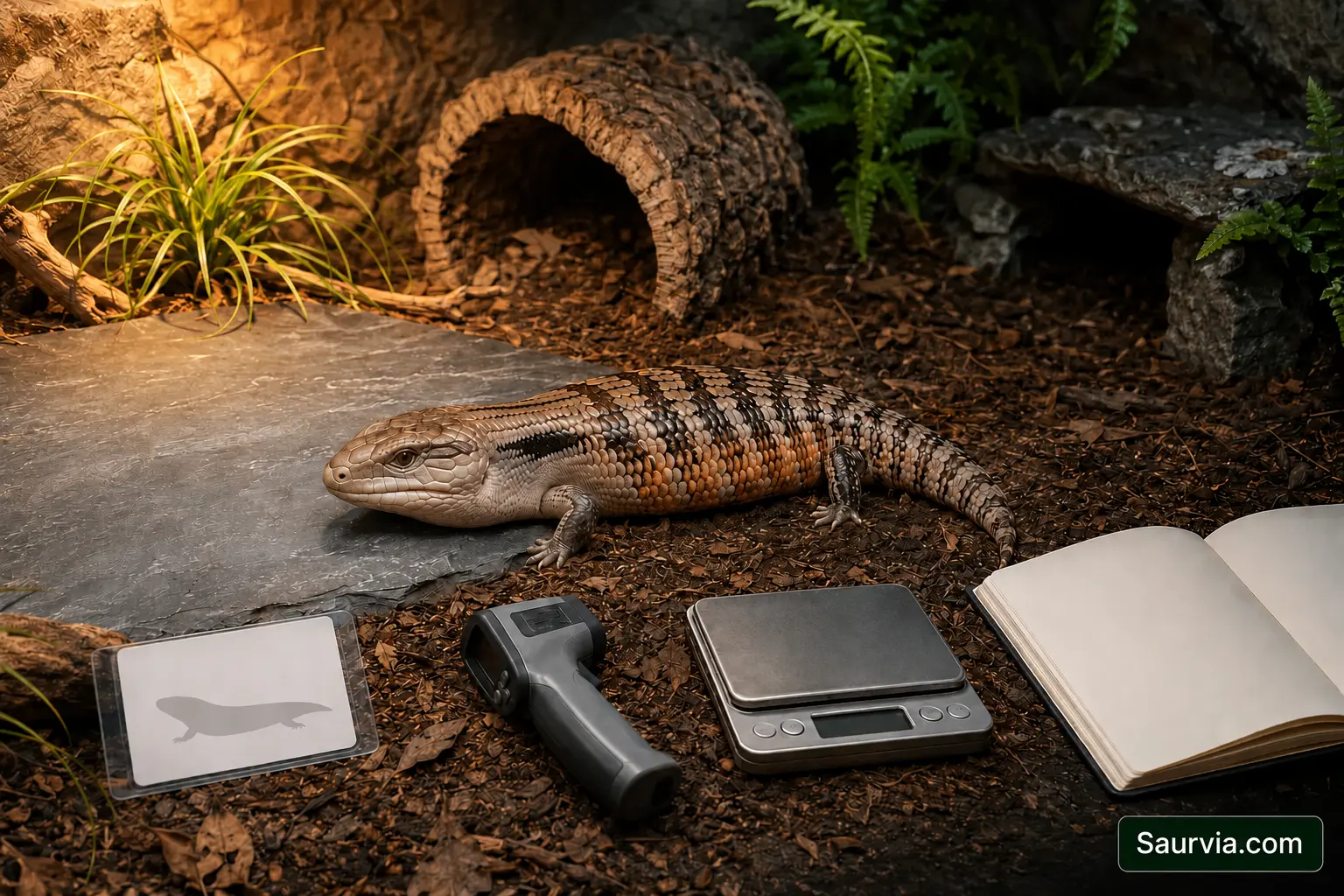
Plan the interior, not the gallon label
The RSPCA advises a minimum 120 × 60 × 60 cm vivarium for one blue-tongue. The Federation of British Herpetologists' May 2022 guidance then takes an animal-relative approach: for skinks including Tiliqua, minimum width × depth × height is 6 × 4 × 3 snout-to-vent lengths for one adult or subadult. For many adults that formula produces dimensions larger than the fixed RSPCA baseline. A 40-gallon enclosure is not an adult recommendation in this guide. [RSPCA 2019] [FBH 2022]
Neither benchmark becomes optional because it comes from professional welfare guidance rather than an experiment. For planning, use the larger applicable footprint instead of allowing a fixed product label to override the animal-relative standard. After measuring snout-to-vent length and calculating all three dimensions, inspect the interior. It must accommodate a broad warm area, a cooler shaded end, multiple secure retreats, water, burrowing opportunity, a feeding area and a route for full-body locomotion and turning without collapsing the gradient.
Field movement cannot be converted into a captive formula. It does, however, undermine the claim that an enclosure is adequate merely because the skink fits inside it. Saurvia therefore retains the RSPCA fixed minimum and current FBH formula as visible planning baselines while Northern-specific captive outcome work remains limited.
Substrate risk depends on the whole system
Field Northerns used litter-rich, concealed core habitat, so digging and cover are more than decorative additions. The observation still cannot establish that every packaged loose material is safe. Composition, particle size, dust, moisture, stability, depth, drainage, feeding method, cleaning, life stage and health status each reshape the exposure.
The RSPCA offers a concrete starting structure: about 10 cm (4 inches) of organic soil or a soil-and-sand mixture, kept clean and managed with the rest of the enclosure. It specifically excludes calcium sand, beech chips, corn-cob granules and crushed walnut shell. It does not prescribe a universal 70:30 ratio, certify cypress mulch or establish a fixed quarantine duration. Very dry, dusty, abrasive or persistently wet material is a reason to correct the system and inspect the animal, not a reason to diagnose an eye, respiratory, skin or gastrointestinal condition at home. [RSPCA 2019]
A healthy, established animal may be managed on a stable, diggable substrate with a clean feeding surface. A new arrival, an animal under investigation or an individual recovering from illness may temporarily need a simpler surface so that intake and waste remain inspectable. The word “bioactive” does not remove the need to monitor food spoilage, moisture, plants, cleanup organisms, sanitation or the skink's destructive use of the enclosure.
Eating a food does not establish that it is a complete staple
Government and institutional sources characterize Northern blue-tongues as broad omnivores. That supports biologically meaningful variety, but it yields neither a captive animal-to-plant percentage nor a calorie allowance or supplement schedule. A list of wild foods cannot simply be copied; nutrient composition, availability, energy density and the animal's life stage all alter the nutritional meaning. [Australian Government 2021] [Smithsonian]
Dog and cat foods illustrate the problem. The category contains many formulations. The wet cat food used before the 2025 UVB experiment neither sustained the study's baseline 25-OHD nor tested long-term dietary completeness for skinks. That experiment supplies no evidence for routine cat-food feeding and cannot be used to validate a staple recommendation.
Professional guidance provides usable starting structures, but it does not converge on the replacement rule proposed in some care discussions. RSPCA describes an adult ration of roughly 50–60% animal matter and 40–50% vegetables, with fruit no more than 10%; suitable canned dog food is only one possible animal item, and a formulated omnivore reptile diet is presented as an alternative. Lafeber instead places fresh greens and mixed vegetables at 45–60% of the adult diet and describes low-fat dog or cat food as an occasional protein source. Neither source identifies grain-free dog food as a validated 50–60% staple. [RSPCA 2019] [LafeberVet]
A reviewable diet record names each product and formulation, the amount offered and consumed, total feeding interval, plant and animal items, insects, supplements, water, storage and freshness; those inputs are then paired with repeatable weight and structured body observations. Calcium, phosphorus, vitamin D, fat and energy must be considered across the whole ration rather than inferred from a “grain-free” label. Nutritional adequacy belongs to the whole ration over time. A brand category, fixed ratio, thick tail or the word “variety” cannot establish it.
Calcium-to-phosphorus balance is not optional simply because Northern-specific nutrient requirements remain incomplete. Merck's general reptile-nutrition reference says the offered diet should reach at least 1:1, with 2:1 preferred, and shows that many common insects and muscle meats begin with inverted ratios. That is a professional whole-diet planning benchmark, not a Northern outcome threshold. [Merck Veterinary Manual]
For adults, Lafeber proposes lightly dusting the diet with plain calcium carbonate—without phosphorus or vitamin D—two to three times weekly just before feeding. Use that as an attributed starting structure only when it fits the foods actually offered. Gut loading, fortified products, measured UVB and every calcium or D3 supplement still need one combined audit; automatic dusting of every unsupplemented animal item would bypass that whole-system check and can overlap with fortified foods or other supplements. [LafeberVet]
Routine checks should lead to records, not home diagnoses
Monthly weight is one useful trend, but no published source in this set validates a rule that the abdomen must remain narrower than the pelvis. Record comparable top and side views, intake and activity alongside weight. Also look at the visible mouth, eyes, feet, ventral scales and skin during ordinary care. Swelling, discharge, bleeding, an unusual odor, persistent eye closure, erosions, marked redness or impaired use are observations to preserve for a reptile veterinarian—not conditions to name or treat from a checklist.
Dental anatomy cannot be used to manufacture a food rule. Jenkins and Shaw classify T. scincoides as pleurodont in their comparative dataset, not acrodont. Their paper does not test canned foods, periodontal disease or “mechanical cleaning” by hard food. It therefore contradicts the proposed acrodont mechanism without proving that any soft commercial diet is safe or nutritionally complete. [Jenkins and Shaw 2020]
General clinical references describe reptile stomatitis as multifactorial and identify acrodont dentition as a particular periodontal vulnerability; they do not establish that soft food alone produces the same disease chain in pleurodont Northerns. Texture therefore should not be declared harmless or used as a substitute for ration quality. Record the formulation and texture offered, inspect the visible mouth during ordinary care and take persistent redness, swelling, discharge, odor, bleeding or impaired feeding to a reptile veterinarian. [De Voe 2019]
The RSPCA recommends fecal examination when droppings are abnormal, weight is falling or another concern exists. Preventive-care guidance addresses a different moment: VCA places weight, oral review and fecal analysis within an annual reptile visit, while cautioning that not every positive parasite finding requires treatment. A practical plan is to keep a fresh sample available for the annual wellness visit and let the reptile veterinarian choose the method, timing and interpretation from the animal's history and examination. Do not infer disease from appearance or deworm from a result without that interpretation. [RSPCA 2019] [VCA 2024]
A seasonal or activity label cannot explain an individual change
The government synthesis describes Northerns as active throughout the year, yet also characterizes them as primarily nocturnal. Direct telemetry, meanwhile, records movement during both day and night: longer relocations occurred mainly in midmorning and late afternoon, while overheating risk appeared to limit midday movement. [Australian Government 2021] [Price-Rees et al. 2014]
The statements do not need to be forced into one label. Activity changes with temperature, season, site and the behavior being counted. Captive lighting should provide a predictable light-dark cycle and meaningful environmental choice; a single word—diurnal, nocturnal or brumating—cannot explain a change in an individual.
When appetite or activity falls, examine identity, hemisphere, actual thermal and light records, duration, weight trend, feces and accompanying signs together. A calendar alone does not normalize persistent food refusal, weight loss, weakness, abnormal breathing or altered mobility; nor does it justify automatic force-feeding, soaking, deworming or temperature escalation.
This guide does not provide a forced-brumation protocol. If a keeper intends to induce a seasonal cycle, the animal's identity, history, body trend and veterinary context need an individualized plan beforehand. The checked sources do not establish an automatic annual fecal test or a universal 5% weight-loss cutoff that can replace assessment of the whole animal and the direction of change.
One Northern Blue-Tongued Skink per enclosure
Field core areas may overlap, but the spatial study cannot establish that two skinks can safely share an enclosure. A large landscape permits separation, shifting resource access and movement between patches. Forced proximity does not reproduce those conditions. The Australian Government also states that detailed data on this taxon's social system are lacking. [Price-Rees et al. 2013, spatial ecology] [Australian Government 2021]
Because blue-tongues are territorial and can injure one another, the RSPCA advises separate housing. [RSPCA 2019] An apparently calm pair does not establish equal access to heat, UVB, food, water and retreats, nor does it provide a controlled rate of harm. The household baseline is one skink per enclosure.
Twelve disagreements, tested against the missing context
“Evidence state” gives the direction that the reviewed material can support today. “Unresolved” identifies what stronger research or a more complete source comparison would still need to settle.
| Claim A | Claim B | Same measurement or context? | Evidence state | What remains unresolved |
|---|---|---|---|---|
| One general care profile is sufficient for any blue-tongue skink. | Northern, Eastern and Indonesian blue-tongues require different context. | No. The common name spans distinct taxa and origins; humidity and seasonal interpretation can diverge before enclosure design is even considered. | Confirm Tiliqua scincoides intermedia and provenance before applying Northern-only guidance. While identity is unresolved, preserve measured choices, water, ventilation and a localized moist refuge rather than inventing a midpoint between incompatible care sheets. | A reliable remote-identification standard for animals with incomplete records, mixed traits or possible hybrid ancestry. |
| Northerns come from a hot region, so their enclosure should be uniformly dry. | Blue-tongues need high ambient humidity. | Not as stated. Taxon, ambient air, substrate moisture, retreat microclimate, ventilation, season and sensor position have all been collapsed into the single word humidity. | Field Northerns selected cool, shaded and relatively damp core patches. RSPCA guidance also separates locality-appropriate ambient humidity, ventilation and a damp moist hide; a localized humid retreat is not an instruction to keep the whole enclosure wet. | A Northern-specific ambient cycle and retreat microclimate linked to standardized measurement positions and health outcomes. |
| The correct basking temperature is in the low-to-mid 90s °F. | The correct basking temperature is above 105°F. | Not until the measurement is named. Professional guidance overlaps in the low-to-mid 30s °C for a labeled basking zone, while higher keeper figures often describe a surface peak; instrument, position, heated area and duration still matter. | RSPCA guidance provides an actionable 30–35°C basking-zone and 22–26°C cool-end proposal. Its implementation uses guarded, thermostat-controlled overhead heat; commission it with cooler shaded retreats while recording surface and air separately. | Northern-specific outcome data that refine surface, air, area and duration without weakening the established need for a usable thermal gradient. |
| A 40-gallon or 4 × 2 ft enclosure is the adult minimum. | Current welfare planning requires more functional floor space. | Older volume or fixed-footprint labels and the current formula do not describe the same animal-relative or functional standard. | RSPCA advises at least 120 × 60 × 60 cm for one blue-tongue; FBH gives Tiliqua 6 × 4 × 3 snout-to-vent lengths. Use the larger applicable planning benchmark and preserve functional complexity. | Northern-specific captive outcome data and the effect of layout, cover and enrichment at different dimensions. |
| Any loose substrate causes impaction. | Natural substrate is safe whenever husbandry is good. | No. Material, moisture, dust, feeding method, depth, hygiene, life stage and health status all change the exposure and risk question. | Burrowing and litter use are meaningful, yet substrate must be assessed as a managed system. RSPCA proposes about 10 cm of organic soil or a soil/sand mixture and excludes calcisand and several manufactured loose materials; arrival or clinical care may call for a temporarily simpler surface. | Comparative captive outcome data for specific substrate systems and animal states. |
| Wet dog or cat food is a proven, complete staple for blue-tongues. | All dog or cat food should be banned. | No. Product formulation, portion, energy density, life stage, accompanying foods and measured outcomes are commonly absent. | The wet-cat-food cohort cannot validate a long-term staple. RSPCA treats suitable canned dog food as one possible animal item, while Lafeber limits low-fat dog or cat food to an occasional protein source; neither makes grain-free dog food a clinical gold standard. | Long-term Northern nutrition outcomes across defined, nutritionally analyzed diets. |
| A fixed animal-to-plant ratio makes a complete diet. | Variety alone makes a complete diet. | No. Neither phrase specifies nutrients, total energy, portion size, supplement exposure, life stage or a longitudinal outcome. | Wild omnivory establishes dietary breadth, not a captive percentage. General reptile guidance also treats an inverted calcium-to-phosphorus ratio as a preventable ration problem; the whole diet, supplement exposure and the animal's trend must be evaluated together. | Validated life-stage nutrient targets, feeding frequency and body-condition criteria for companion Northerns. |
| A thick body and tail prove that the skink is healthy. | Appearance alone is enough to reduce food. | No. Image angle, body structure, hydration, reproductive status, mass trend and examination context can each alter the impression. | Use repeatable weight alongside structured observations; neither a photograph nor a single scale reading constitutes a diagnosis. | A validated, practical Northern body-condition scoring system. |
| Reduced appetite or increased hiding is normal brumation. | Any seasonal change proves illness. | No. Taxon, hemisphere, environmental records, duration, weight, feces and accompanying signs determine whether two cases are even comparable. | The calendar alone cannot provide reassurance. Review measurements and trends; unexplained change or accompanying concerning signs warrant a reptile veterinarian's evaluation. | Reviewed seasonal-monitoring and referral boundaries for captive Northerns. |
| Northern blue-tongues are diurnal. | Northern blue-tongues are primarily nocturnal. | The labels summarize different observations. Field telemetry recorded activity by day and night, with longer movements concentrated at particular times and midday overheating apparently limiting movement. | Provide a predictable light-dark cycle and observe the individual rather than deriving a captive schedule from one activity label. | How season, locality, temperature and captive conditions shift activity budgets. |
| Field overlap shows that blue-tongues can live together. | One skink per enclosure is the household baseline. | No. Sequential or spatial overlap across a large landscape does not reproduce forced proximity, constrained resource access or limited escape options in an enclosure. | House one skink per enclosure. An exceptional managed display does not establish the safety of companion-animal cohabitation. | The social system remains poorly described; that knowledge gap does not validate household cohabitation. |
| Dietary vitamin D makes UVB unnecessary. | An experimental UVB schedule can be copied into home care. | No. Diet formulation, lamp output, enclosure geometry, shade, life stage, biomarker target and purpose of exposure all differ. | Tiliqua scincoides can raise plasma 25-OHD after UVB exposure. Provide a measured UVB gradient with shade and audit every dietary D3 source; a lamp label alone neither sets UVI nor makes unmeasured supplement stacking safe. | Northern-specific reference intervals and a safe routine protocol integrated with diet and supplementation. |
The current attributed care baseline
- Confirm T. s. intermedia and provenance before applying Northern-specific environmental or seasonal guidance.
- Start no smaller than the RSPCA 120 × 60 × 60 cm recommendation, calculate the FBH 6 × 4 × 3 snout-to-vent-length benchmark and use the larger applicable plan.
- Use the attributed RSPCA 30–35°C basking-zone and 22–26°C cool-end proposal without mixing surface and air readings; record instrument, position, area and time.
- Use guarded, thermostat-controlled overhead heat as the RSPCA implementation baseline; verify what reaches the basking surface and the warm and cool air rather than treating a controller setting as exposure.
- Pair controlled warmth with cooler, shaded and concealed choices. Keep locality-appropriate ambient humidity and ventilation distinct from the separate moist hide recommended for shedding support.
- Treat UVB as a meter-verified gradient with access to zero-UVI shade. If using the RSPCA 6% tube example, preserve its 60 cm enclosure height, placement, reflector and measurement conditions.
- Audit dietary and supplemental D3 together; a well-set UV system is not a reason to stack high-D3 products, and a lamp label is not a supplement plan.
- Use no UVB experiment as permission for routine cat-food feeding. Audit the whole ration, keep its calcium-to-phosphorus balance from becoming inverted and reconcile plain-calcium use with fortified foods, measured UVB and every D3 source.
- For an established healthy animal, the RSPCA proposes about 10 cm of organic soil or a soil/sand mixture; exclude calcium sand, beech chips, corn cob and crushed walnut, and use an inspectable temporary surface when arrival or clinical context requires it.
- Record visible changes in droppings, mouth, eyes, feet, ventral scales, mobility, intake and weight; plan an annual reptile-veterinary wellness visit with a fresh fecal sample available, and leave test selection, interpretation and treatment to that clinician.
- House one Northern Blue-Tongued Skink per enclosure.
Where the Northern-specific evidence still stops
Saurvia has not established a Northern-only outcome threshold for basking-surface temperature, ambient humidity, retreat humidity, UVI, a Northern-specific calcium-to-phosphorus target, supplementation, diet composition, feeding frequency, substrate, seasonal change or body condition. That limitation does not erase the attributed welfare baselines above. It marks the point where a professional proposal ends and a Northern-specific validated outcome has not yet begun.
Under Assessment means this synthesis remains open to source corrections, evidence-based criticism and editorial revision. It does not mean academic peer review or veterinary approval is pending. Stronger captive-outcome research, materially revised professional guidance, changed taxonomic treatment or a correction to a central conclusion will trigger another source-traceable revision.